

A linux audiobook player needs to do things a regular music app never bothers with, like remembering chapter position across hundreds of minutes and sorting titles by reader instead of artist. VLC and MPV play the files fine, but neither treats an audiobook as a book.
Cozy fills that gap on the Linux desktop, and this guide covers installing it, setting it up, fixing the handful of problems it has and what to reach for when it is not the right tool for the job.
What is Cozy and why Linux needs a dedicated audiobook player
Cozy is a modern, open-source audiobook player built for the Linux desktop, released under the GPL 3.0 license and written in Python with a GTK4 interface. It plays DRM-free audiobooks stored locally or on a network drive, in formats including MP3, M4B, M4A, FLAC, OGG and WAV.
A regular music player treats an audiobook the same as a song, which breaks down fast once a book runs eight or ten hours across dozens of files.
Cozy solves that by tracking chapter position automatically, sorting by author and reader instead of artist, and treating each folder as one continuous book rather than a pile of tracks.
Here is what it offers beyond basic playback:
- Imports your whole library and watches multiple storage locations at once.
- Remembers playback position per book, so you pick up exactly where you stopped.
- Includes a sleep timer that stops playback automatically after a set time.
- Lets you set playback speed individually for each book.
- Offers an offline mode that caches a book locally even when your library lives on a network drive.
- Supports drag-and-drop imports and full-library search.
- Integrates with MPRIS, so desktop media keys and sound applets can control playback.
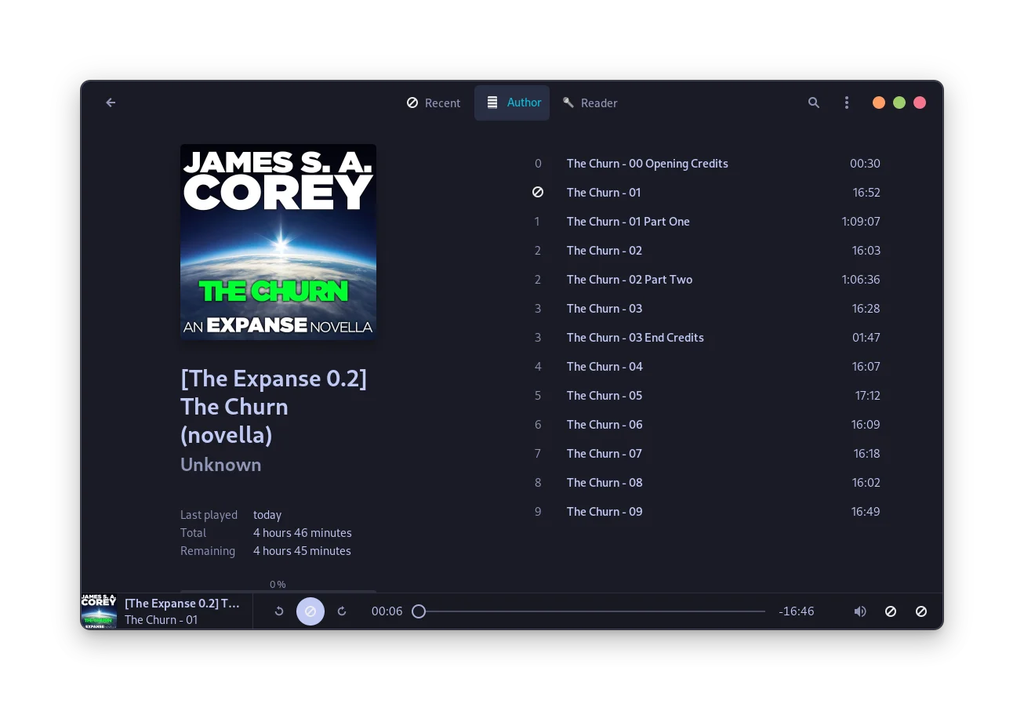
Cozy started out in 2017 as a GTK3 app that only handled MP3, FLAC and OGG files. Version 1.3.0 rebuilt the interface on GTK4 and libadwaita, adding dark mode, GNOME accent colors and the wider format and offline support listed above.
Releases have slowed since that update landed in early 2024, but the project still gets bug fixes and translation updates, and it stays actively packaged across every distribution covered below.
How to install Cozy on Linux
Cozy ships through most major distributions, either as a native package or through Flatpak. Pick whichever matches your setup below.
Ubuntu and Debian
Recent Ubuntu releases, 24.04 and newer, carry Cozy directly in the universe repository, so no extra repository is needed:
sudo apt update
sudo apt install cozy
Older releases can fall back to the Cozy PPA:
sudo add-apt-repository ppa:cozy-team/cozy
sudo apt update
sudo apt install cozy
If add-apt-repository is missing on a minimal install, this fix covers installing it first. Debian ships the same cozy package name on current releases, so the install command above works there too.
Fedora Workstation
Install it straight from the repositories using the DNF command:
sudo dnf install cozy
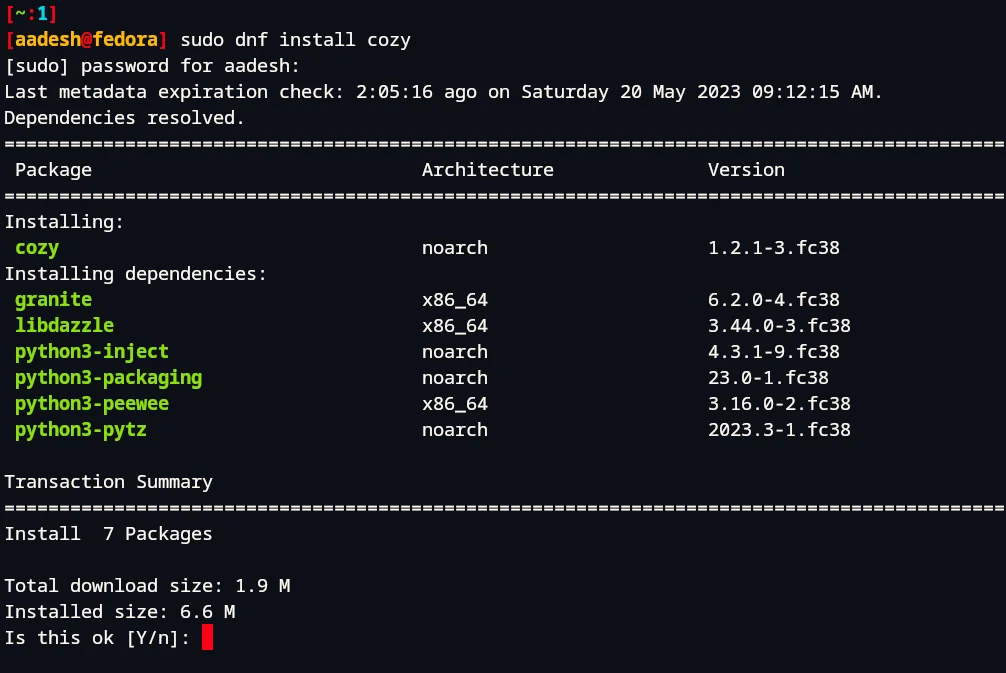
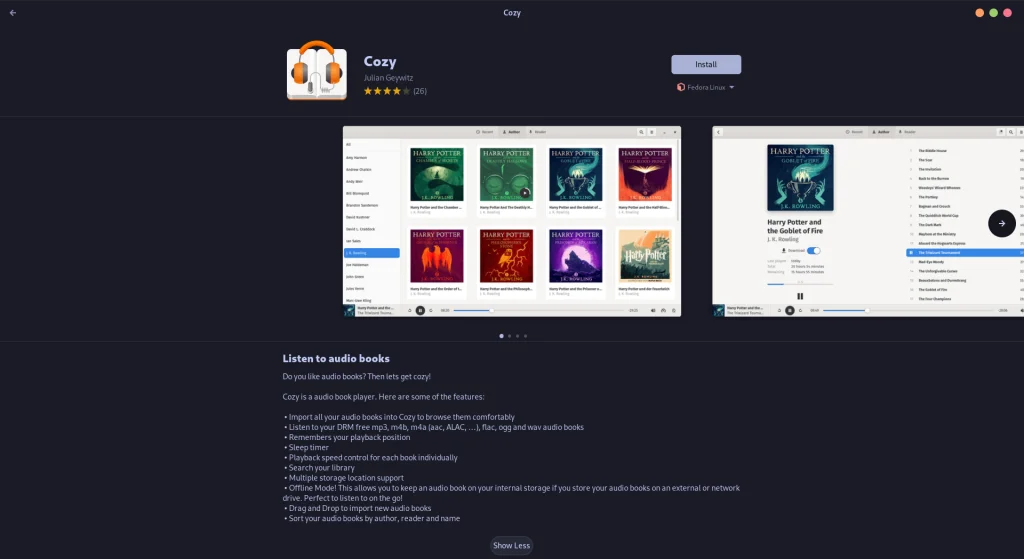
Prefer a graphical install instead of the terminal? The GNOME Software store lists Cozy too, and installing from there works exactly the same way.
Arch Linux
Cozy lives in the Arch User Repository under the name cozy-audiobooks. Grab it with an AUR helper such as yay or paru:
yay -S cozy-audiobooks
Paru has picked up a following since yay’s original co-developer shifted his focus to building it, though yay itself is still maintained and works fine here too.
Flatpak: works on any distribution
If your distribution is not covered above, or you would rather sandbox the app entirely, Flatpak is the most reliable path. Enable Flathub first, then run:
flatpak install flathub com.github.geigi.cozy
openSUSE and other distributions
Cozy also ships natively on openSUSE through zypper install cozy, plus Void Linux, Solus, MX Linux, NixOS and OpenBSD, since the project maintains packaging for each. Flatpak remains the fallback for anything not on this list.
Setting up Cozy for the first time
Launching Cozy for the first time drops you into a short setup flow before any audiobook plays.
You will land on the welcome screen first. Click “Continue” to move past it.
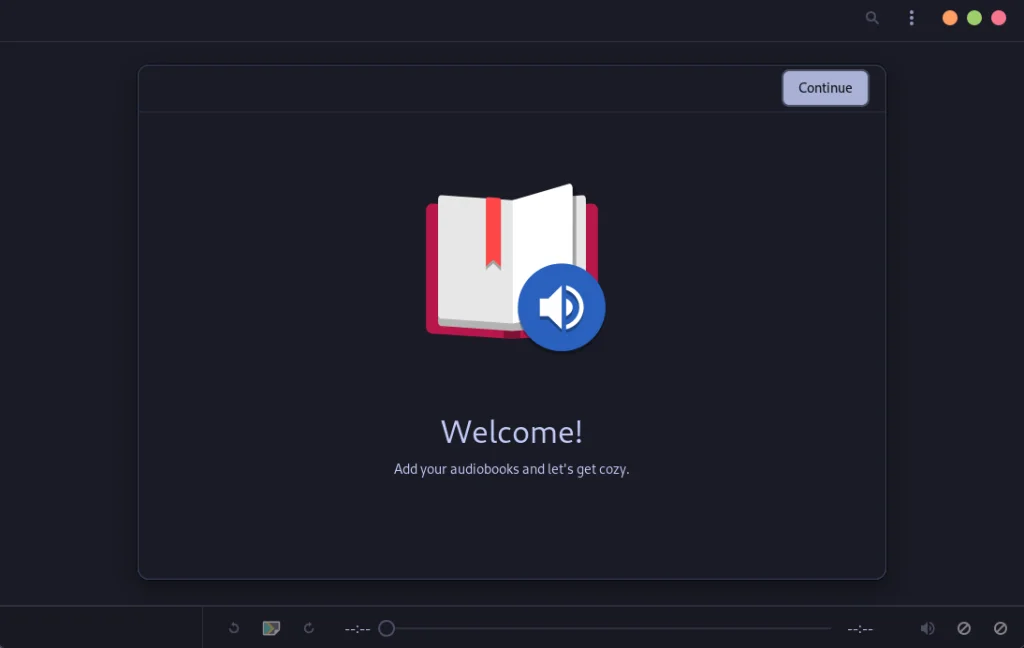
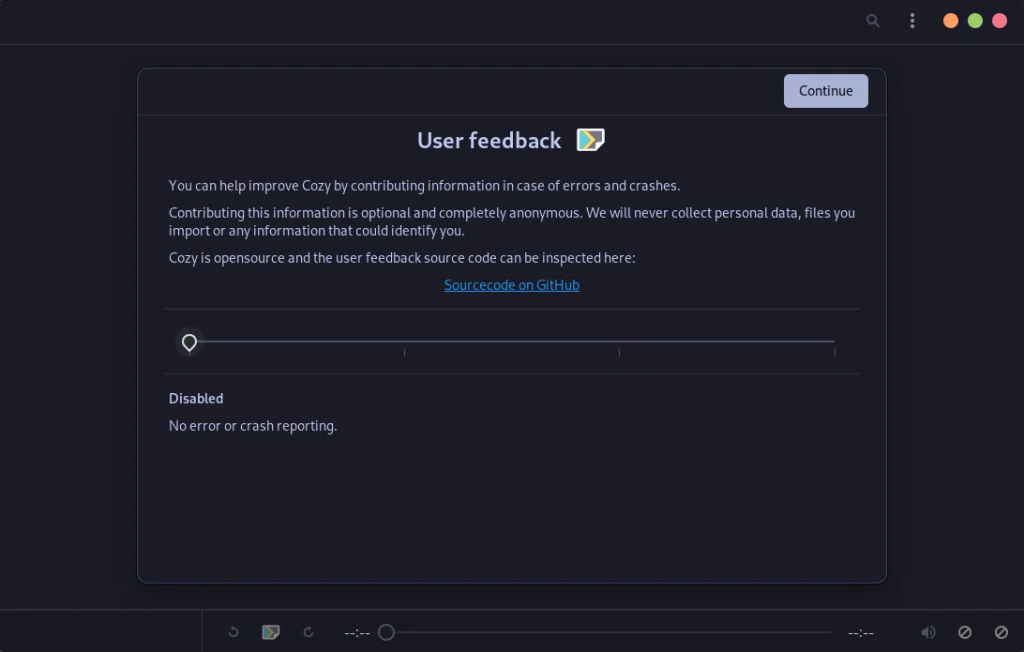
Next comes a prompt about sending telemetry, such as crash reports, to the developer. Disabling it is a reasonable default for most people, though leaving it on does help the project catch bugs faster.
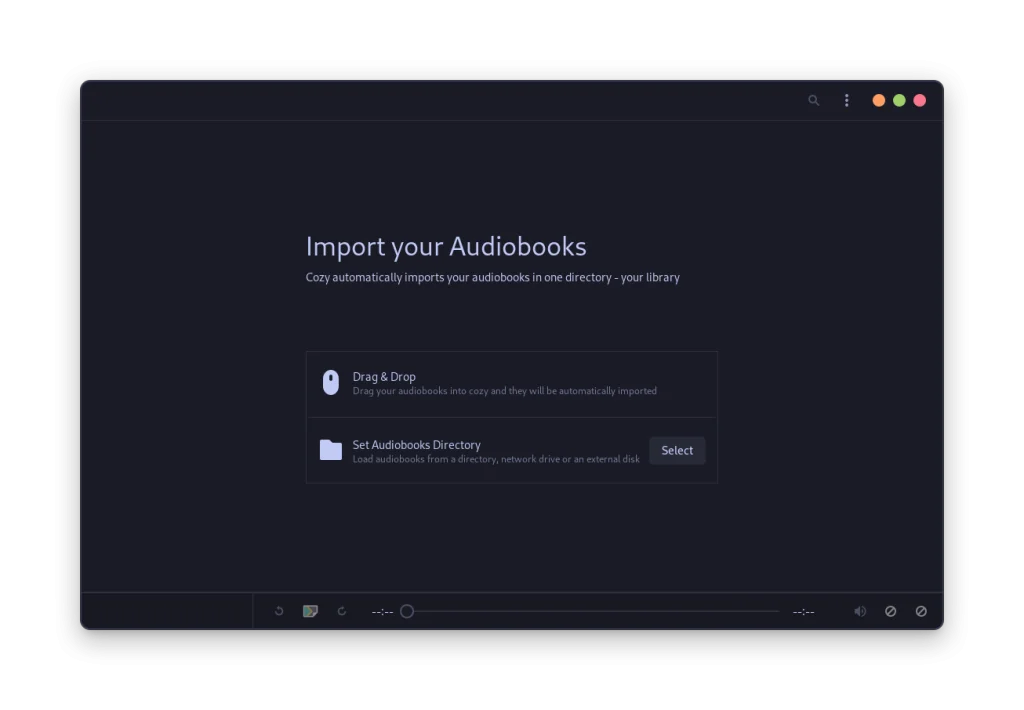
Finally, point Cozy at the folder where your audiobooks live, whether that is a local directory or a network share.
Once the scan finishes, your whole library shows up in a grid view, sorted by whichever field you chose during setup.
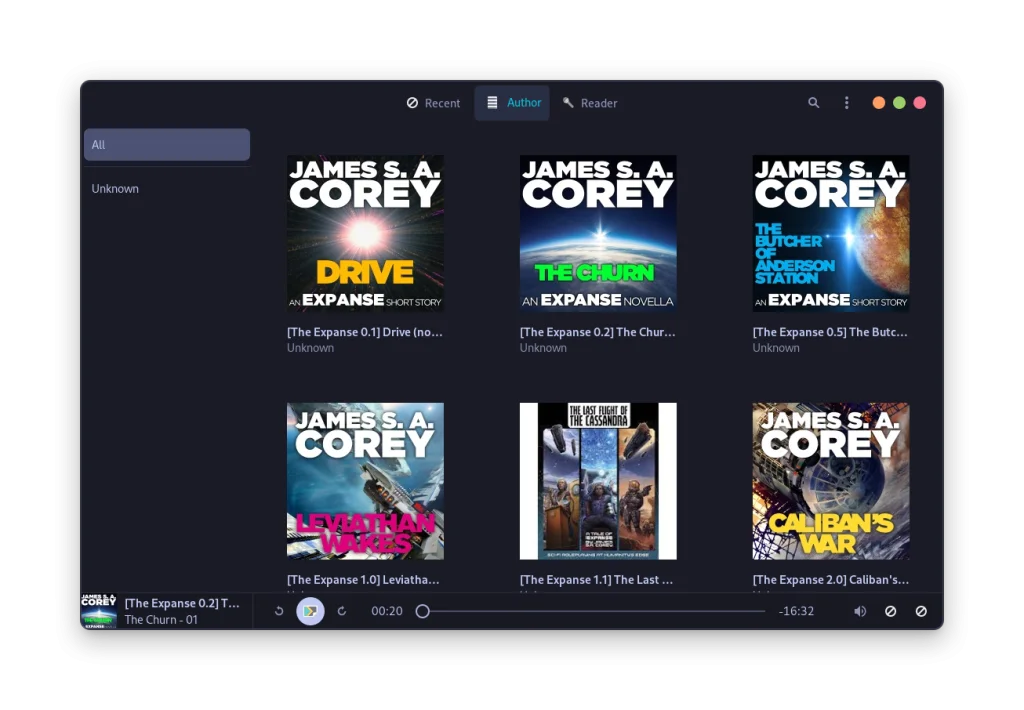
On a GNOME desktop running a current release, this same grid view also picks up your system accent color automatically, a side effect of the libadwaita interface Cozy adopted in version 1.3.0.
Troubleshooting common Cozy problems
Most Cozy issues trace back to one of two things: Flatpak’s sandboxing, or a distro package that lags a release or two behind the GitHub source.
Icons render blank or broken: This shows up occasionally on Fedora, usually tied to a missing theme dependency in the distro package. Switching to the Flatpak build sidesteps it, since it bundles its own runtime and does not depend on system themes.
Flatpak cannot see your audiobook folder: Flatpak sandboxes every app by default, so a folder outside the standard locations needs explicit access:
flatpak --user override --filesystem=/media com.github.geigi.cozy
Flatseal does the same job through toggles instead of flags, and makes it easy to see every permission Cozy currently holds.
You need to reset your library: Delete Cozy’s data and cache folders for a clean slate, though this clears all saved progress:
rm -rf ~/.local/share/cozy ~/.cache/cozy
The Flatpak version will not uninstall cleanly: A plain flatpak uninstall sometimes leaves the app listed anyway. Force it with:
flatpak uninstall --user com.github.geigi.cozy
Every book lists the reader as “Unknown”: This happens when a book’s metadata does not separate author from narrator cleanly. Open Preferences and enable “Swap Author and Reader,” which fixes the mislabeling for most public-domain downloads.
Where to find free audiobooks for Cozy
Cozy only opens DRM-free files, so a few sources cover most of what a new library needs:
- LibriVox: public-domain audiobooks read entirely by volunteers. Quality varies between readers, but the catalog is large and completely free.
- Project Gutenberg: links out to audio versions of many public-domain texts already in its library.
- Open Culture: keeps a running, regularly updated list of free audiobook sources worth bookmarking.
- Libro.fm: sells current, copyrighted titles as DRM-free downloads, so anything bought there opens in Cozy the same way a ripped CD would.
None of these cover audiobooks already locked into Audible’s format. For those, see OpenAudible below.
Other Linux audiobook player options for different needs
Cozy covers most desktop use cases, but a few situations call for something else entirely.
For Audible purchases: OpenAudible
Cozy cannot open anything still wrapped in Audible’s DRM. OpenAudible fills that gap by connecting to your Audible account, downloading purchased books and converting them to MP3 or M4B that Cozy can open. It runs natively on Linux and has been actively maintained since 2020.
For phones running Linux: Phonic and Audiobook QML
Cozy is built for a desktop screen, not a phone. If your audiobooks need to follow you onto a device running postmarketOS or Mobian, Phonic and Audiobook QML both target mobile Linux specifically.
Both are listed in the LinuxPhoneApps.org directory, along with compatibility notes and packaging details for individual devices.
For a no-frills setup: VLC and MPV
If you just want to point a regular player at a folder of MP3s without managing a library at all, MPV and VLC still play audiobook files without complaint. You lose chapter memory, reader sorting and a sleep timer, though for a short book that trade might not matter.
For multiple devices or a household: Audiobookshelf
Cozy is a single-user desktop app, so it will not sync progress to your phone by itself. Audiobookshelf covers that instead:
- Runs as a self-hosted server, usually through Docker, with a web player plus native Android and iOS apps.
- Keeps separate progress per user, which suits a household sharing one server.
- Serves podcasts from the same library alongside audiobooks.
The tradeoff is setup effort, since it needs a server running most of the time, where Cozy only needs a folder.
Is Cozy still worth installing
Cozy remains one of the only Linux-native apps built specifically around how audiobooks differ from music, and that focus still holds up years after its first release. The rough edges it has are minor, well documented and easy to work around with the fixes above.
For anyone with a folder of DRM-free audiobooks and one desktop to listen from, it is still the simplest option on Linux. The alternatives above exist for cases Cozy was never built to cover, like Audible libraries or multi-device households, not because it falls short at its actual job.
Key takeaways
- Cozy is a free, open-source audiobook player built specifically for Linux desktops.
- Version 1.3.0 moved the interface to GTK4 and libadwaita with dark mode support.
- Recent Ubuntu releases carry Cozy directly in universe, so no PPA is required.
- Flatpak is the most reliable install method across any distribution.
- Cozy only plays DRM-free files, not Audible’s protected format.
- OpenAudible converts Audible purchases into files Cozy can open.
- Flatpak’s sandboxing means external folders need a permission override.
- Mobile Linux users should look at Phonic or Audiobook QML instead.
Frequently asked questions
Does Cozy work with Audible audiobooks?
No. Cozy only plays DRM-free formats like MP3 and M4B. Audible files need a tool such as OpenAudible to convert them before Cozy can open them.
Why does Cozy show blank or broken icons on Fedora?
This usually comes from a missing theme dependency in the distro package. Installing the Flatpak version instead, which bundles its own runtime, generally fixes it.
How do I let Cozy see audiobooks on an external drive?
Grant filesystem access with flatpak --user override --filesystem=/path com.github.geigi.cozy, or use Flatseal for the same change through a graphical toggle.
Is there a Cozy app for Android or iOS?
No official mobile app exists. For mobile Linux phones, Phonic and Audiobook QML are built for that screen size instead.
Can I use Cozy without Flatpak on Ubuntu?
Yes. Ubuntu 24.04 and newer include Cozy in the universe repository, so sudo apt install cozy works without adding any PPA.
What happens if I reset Cozy’s library?
Deleting ~/.local/share/cozy and ~/.cache/cozy clears all playback progress and imported books, giving you a clean library to rebuild from scratch.
Conclusion
Cozy has stayed a small, focused project for years, and that focus is exactly why it still holds up against newer competition on the Linux desktop.