
Unimatrix draws the falling green character columns associated with The Matrix inside a terminal. The current Unimatrix repository supports custom colors, character sets, speed controls, timed runs, and keyboard input, but the package name needs care during installation.
If terminal navigation and shell commands are new to you, keep the Linux command line reference nearby while you install and customize the program.
Install Unimatrix from its source repository
Install the terminal effect from the will8211/unimatrix repository. Do not run pip install unimatrix by itself because the matching Python Package Index project is a different framework library, not the terminal animation.
The simplest user-scoped setup copies the project script into your local executable directory without sudo or changes to the system interpreter.
mkdir -p ~/.local/bin
curl -L https://raw.githubusercontent.com/will8211/unimatrix/master/unimatrix.py -o ~/.local/bin/unimatrix
chmod a+rx ~/.local/bin/unimatrix
The chmod command makes the downloaded script executable. If file permissions are unfamiliar, the chmod and chown reference explains how executable bits affect a command.
Confirm that your shell can locate the script and display its built-in manual.
~/.local/bin/unimatrix -h
If the shell reports command not found when you type unimatrix without the full path, add the local binary directory to PATH and reopen the terminal.
printf '\nexport PATH="$HOME/.local/bin:$PATH"\n' >> ~/.bashrc
source ~/.bashrc
unimatrix -h
The Bash startup-file guide explains when Bash reads .bashrc and .bash_profile.
Install from a cloned repository
A cloned checkout is a better fit when you want to inspect the source or contribute changes. The project uses pyproject.toml, so pip can build and install the command from that checkout.
git clone https://github.com/will8211/unimatrix.git
cd unimatrix
python3 -m venv .venv
. .venv/bin/activate
python -m pip install .
unimatrix -h
The virtual environment keeps this command separate from system Python packages. Review package management on Linux if you need to choose between repository packages, application bundles, and language-specific installers.
Run the Matrix terminal effect
Start Unimatrix with its defaults after installation.
unimatrix
The program fills the active terminal with moving katakana, numbers, and symbols. Press q, Space, or Ctrl+C to exit.
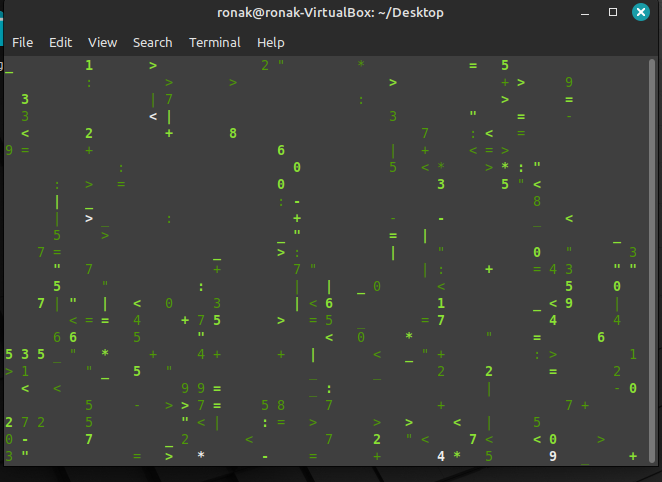
The retained terminal view shows the same default green columns and mixed characters as the current project screenshot. The exact spacing changes with terminal size and while the animation runs.
Customize color, speed, and characters
Unimatrix accepts short options for the foreground color, refresh speed, and character list. Speed uses an integer up to 100, where higher values reduce the delay between refreshes.
| Goal | Command | Behavior |
|---|---|---|
| Blue text with the word Linux | unimatrix -b -u Linux -c blue | Uses bold custom characters in blue |
| CMatrix-like display | unimatrix -n -s 96 -l o | Uses the old non-Unicode set without bold text |
| Slow emoji and number mix | unimatrix -n -l ens -s 50 | Combines emoji, numbers, and symbols at a lower speed |
| Timed background-safe run | unimatrix -t 10 -i | Uses a timer and ignores keyboard input |
The -l option selects built-in character groups such as k for half-width katakana, n for numbers, e for emoji, s for film-style symbols, and o for the old non-Unicode set.
unimatrix -c cyan -l kns -s 90
Use -u when you want an exact custom character string. Quote strings that contain shell punctuation so Bash does not interpret those characters before Unimatrix receives them.
unimatrix -b -u 'LINUX' -c blue
Use the keyboard while Unimatrix runs
Keyboard controls let you change the animation without restarting it. These controls apply to the focused terminal window.
- Press the Left or minus key to reduce speed by one, and the Right or plus key to increase it by one.
- Press the Down or left-bracket key to reduce speed by ten, and the Up or right-bracket key to increase it by ten.
- Press a to toggle asynchronous scrolling, b to cycle bold modes, and f to toggle flashing characters.
- Press 1 through 9 to change the foreground color.
- Press q, Space, or Ctrl+C to stop the program.
Fix common Unimatrix problems
Most failures come from installing the unrelated PyPI project, an executable path that Bash cannot see, or a terminal that cannot display the selected Unicode characters.
The command opens the wrong Python package
Remove the package installed from the public package index, then install the terminal script from the source repository. A bare pip install unimatrix command resolves to the unrelated Unimatrix Core package.
python3 -m pip uninstall unimatrix
mkdir -p ~/.local/bin
curl -L https://raw.githubusercontent.com/will8211/unimatrix/master/unimatrix.py -o ~/.local/bin/unimatrix
chmod a+rx ~/.local/bin/unimatrix
Bash reports command not found
Run the script by its complete path first. If that works, add $HOME/.local/bin to PATH using the earlier .bashrc command.
~/.local/bin/unimatrix -h
printf '%s\n' "$PATH"
Characters appear as boxes
Choose the old non-Unicode character set to confirm that the program itself works.
unimatrix -n -l o
If that display works, select a terminal font with katakana support before returning to the default set. The terminal emulator and font control glyph rendering, while Unimatrix controls which characters it sends.
Choose Unimatrix or CMatrix
Unimatrix is a Python script with Unicode sets, custom text, timed runs, and interactive controls. CMatrix is a separate compiled terminal program that is commonly available through Linux package managers.
Choose Unimatrix when custom characters and the Python implementation matter. Choose CMatrix when you prefer a distribution package and a smaller option set is enough.
Remove Unimatrix
Delete the user-scoped script if you installed it with curl or wget.
rm ~/.local/bin/unimatrix
For a virtual-environment installation, remove the environment directory after leaving it. Run unimatrix -h before removal if you need to confirm which installation your shell finds.