
KDiskMark gives you a graphical view of disk throughput while using fio, the Flexible I/O Tester, underneath. Install it from your distribution repository or Flathub, then run the same profile more than once before you compare a drive with a product specification or another machine.
I checked the current Debian package metadata and the project’s installation instructions while preparing these commands. The useful result is not a single large number. You need to know whether sequential transfer, small random I/O, or the test profile matches the work you want the drive to perform.
Install KDiskMark on Linux
Use the package source your distribution maintains when it has KDiskMark, or use the project’s Flathub package when you already manage desktop applications with Flatpak.
Debian and Ubuntu
Current Debian repositories provide the kdiskmark package with fio, so refresh the package index before installing.
sudo apt update
sudo apt install kdiskmark
Ubuntu can use the same command when its enabled repositories contain the package, which keeps updates on the normal package path.
Fedora and Arch Linux
Fedora and Arch Linux both provide KDiskMark under the kdiskmark package name.
sudo dnf install kdiskmark

sudo pacman -S kdiskmark
Run the command that matches your distribution, not both commands. The Fedora package transaction below shows KDiskMark and fio among the resolved packages, which matters because KDiskMark uses fio for the workload.
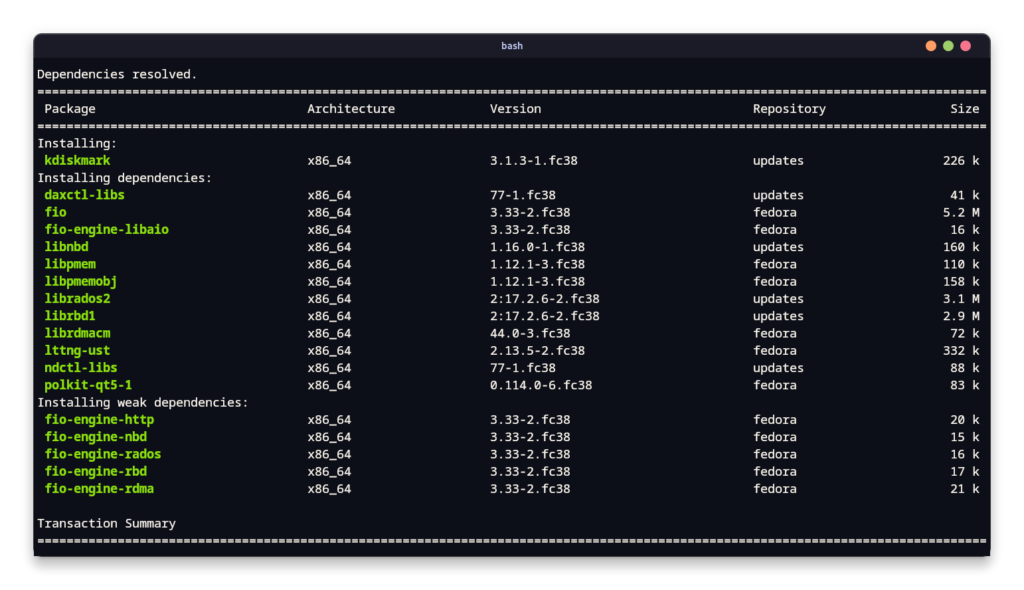
If you need a graphical package manager, search for KDiskMark and confirm the package name before installing. The terminal route makes the package source and dependency list visible.
Install the Flathub package
Flathub publishes KDiskMark as io.github.jonmagon.kdiskmark, and the Linux Flatpak and Flathub setup steps configure Flatpak and the Flathub remote when you need them.
flatpak install flathub io.github.jonmagon.kdiskmark
Use Flatpak when you want the application runtime managed separately from distribution packages, or use the repository package when you prefer system-managed updates.
Choose the drive and a profile before you run the test
Launch KDiskMark from your application menu. Select the target volume in the drive menu, then leave the profile at Default for a first comparison unless you have a workload that calls for a different mix of sequential or random I/O.
Do not point a write benchmark at a mounted volume with work you cannot lose. Benchmarking writes data through the selected path, so use a test volume or make a current backup before you change write-oriented settings.
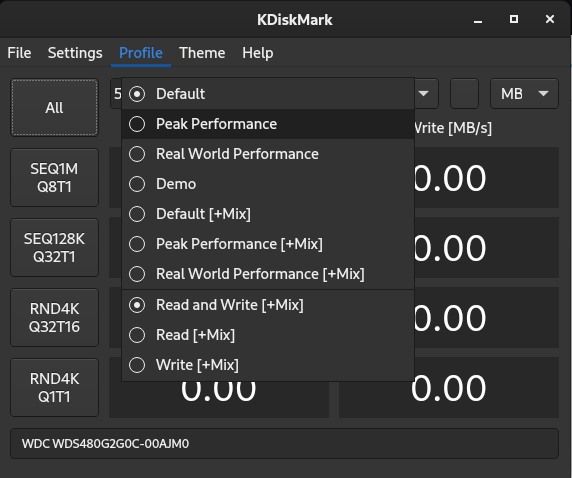
The profile menu makes the comparison rule visible. Keep the same profile, test size, queue depth, and thread count when you compare two drives. Changing those settings changes the workload, which makes the numbers a different measurement.
Run a benchmark and read the result
Press All to run the selected tests and read the MB/s results as separate measurements for sequential and random workloads, because a fast sequential result does not guarantee fast small-file work.
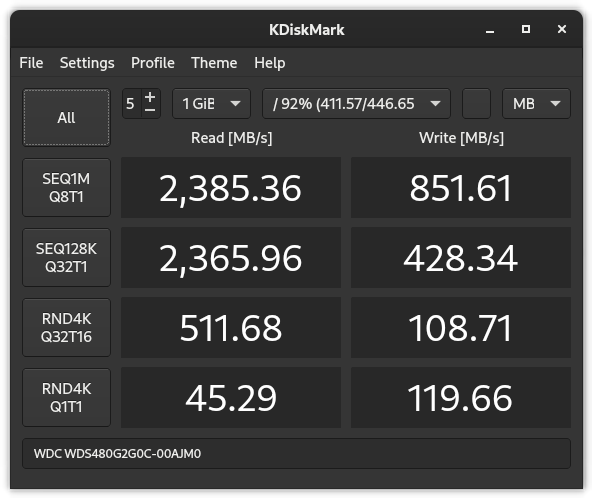
Sequential rows describe long contiguous transfers, while random rows better reflect smaller reads and writes in application data, package caches, and virtual machines.
| Result | Use it to assess |
|---|---|
| Sequential read | Large-file reads and media playback |
| Sequential write | Large copies, exports, and captures |
| Random read | Small-file reads and application data access |
| Random write | Small writes, caches, and database-like workloads |
Repeat an unexpectedly low result with the same profile, then check free capacity with the df command because a nearly full filesystem changes the conditions under which the drive works.
Use the result to investigate a storage problem
KDiskMark isolates storage throughput, not every cause of a slow desktop. If the benchmark looks normal but the system remains slow, inspect CPU, memory, and disk activity with the Linux monitoring commands before you replace hardware.
For a removable drive, confirm its filesystem before you treat a throughput result as a hardware fault. The filesystem detection guide helps you identify an unmounted partition, while the USB formatting guide covers a clean reformat when you have already copied the data elsewhere.
KDiskMark FAQ
These answers keep the benchmark focused on a comparable workload and a safe target volume.
Is KDiskMark safe to use on a drive with files?
KDiskMark can run write-oriented benchmarks against the selected volume. Use a test volume or make a current backup before changing write settings, and confirm the target volume before you start.
Why do KDiskMark results change between runs?
Drive cache state, free capacity, background disk activity, temperature, and different profile settings can change a result. Compare repeated runs only when the selected volume and profile settings match.
Does KDiskMark use fio?
Yes. KDiskMark presents benchmark results in a graphical interface and uses fio, the Flexible I/O Tester, for the underlying disk I/O workload.
Save the result with the profile name and target drive, then use the same settings for a later comparison. If you need a broader system baseline alongside storage throughput, compare it with Geekbench on Linux.