

Slack’s Linux download page never prints a version number, so the choice between four package formats is made blind.
All of them carry the same build today, and it is 4.52.155. I compared the checksum of the .deb from Slack’s download host against the one in Slack’s own apt repository index, and I read the dependency list out of the package itself.
What Slack ships for Linux today
Slack’s desktop client is an Electron application, and the download host carries it for x86_64 machines only. The same 4.52.155 build, dated 2026-08-27, arrives through four channels.
| Channel | Package | Installed by | Version served |
|---|---|---|---|
| Debian, Ubuntu | slack-desktop | apt or dpkg | 4.52.155 |
| Fedora, RHEL, Rocky | slack | dnf or rpm | 4.52.155 |
| Snap | slack | snapd | 4.52.155 |
| Flatpak | com.slack.Slack | flatpak | 4.52.155 |
Slack’s help centre lists Ubuntu and RHEL as the supported distributions and still calls the Linux app a beta. The same packaging shows up for other team clients, and Mattermost and Element follow it closely enough that the commands transfer. Everything else runs through snap or Flatpak, which is why those routes belong here beside the .deb.
Architecture decides more than the distribution does. I checked the snap’s published channel map and the Flathub refs, and both carry amd64 alone, while the download host answers 404 for the arm64 file names. On a Raspberry Pi or an Ampere VM, none of these routes installs.
What you need before the first command
The prerequisites are short, and the only one with a wrong answer is the channel, so read that bullet twice.
- A machine with an x86_64 processor. Check with uname -m and look for x86_64.
- sudo rights, and roughly 250 MB free for the app plus its GTK and NSS dependencies.
- A choice of channel. Snap and Flatpak update themselves, the .deb adds Slack’s apt repository and rides along with apt upgrade, and the .rpm does the same for dnf.
A naming trap is worth knowing before anything else runs. On Ubuntu and Debian the package named slack is not this application. It is a small administration tool in universe, version 1:0.15.2-11, and apt installs it happily for a reader who types apt install slack expecting a chat client.
Installing Slack on Ubuntu and Debian
The .deb is the only route that hands the app to your own package manager, so updates arrive with the rest of your system. Fetch the file, check it, then install it.
Download and verify the current .deb
Slack hides the version in the file name, which is why the link below carries it. Fetch the file with wget, then hash it.
wget https://downloads.slack-edge.com/desktop-releases/linux/x64/4.52.155/slack-desktop-4.52.155-amd64.deb
sha256sum slack-desktop-4.52.155-amd64.deb

Slack’s apt repository lists the same artefact at 94,856,778 bytes with SHA256 966536026f5afcd1c75a395dddd87b9596580931f659b40cebb21ab3add71b2f. I ran the hash on the file I downloaded and got the same string, which is what tells you it arrived whole.
I read the control archive before installing anything, and it names the version and every dependency up front.
dpkg-deb -I slack-desktop-4.52.155-amd64.deb
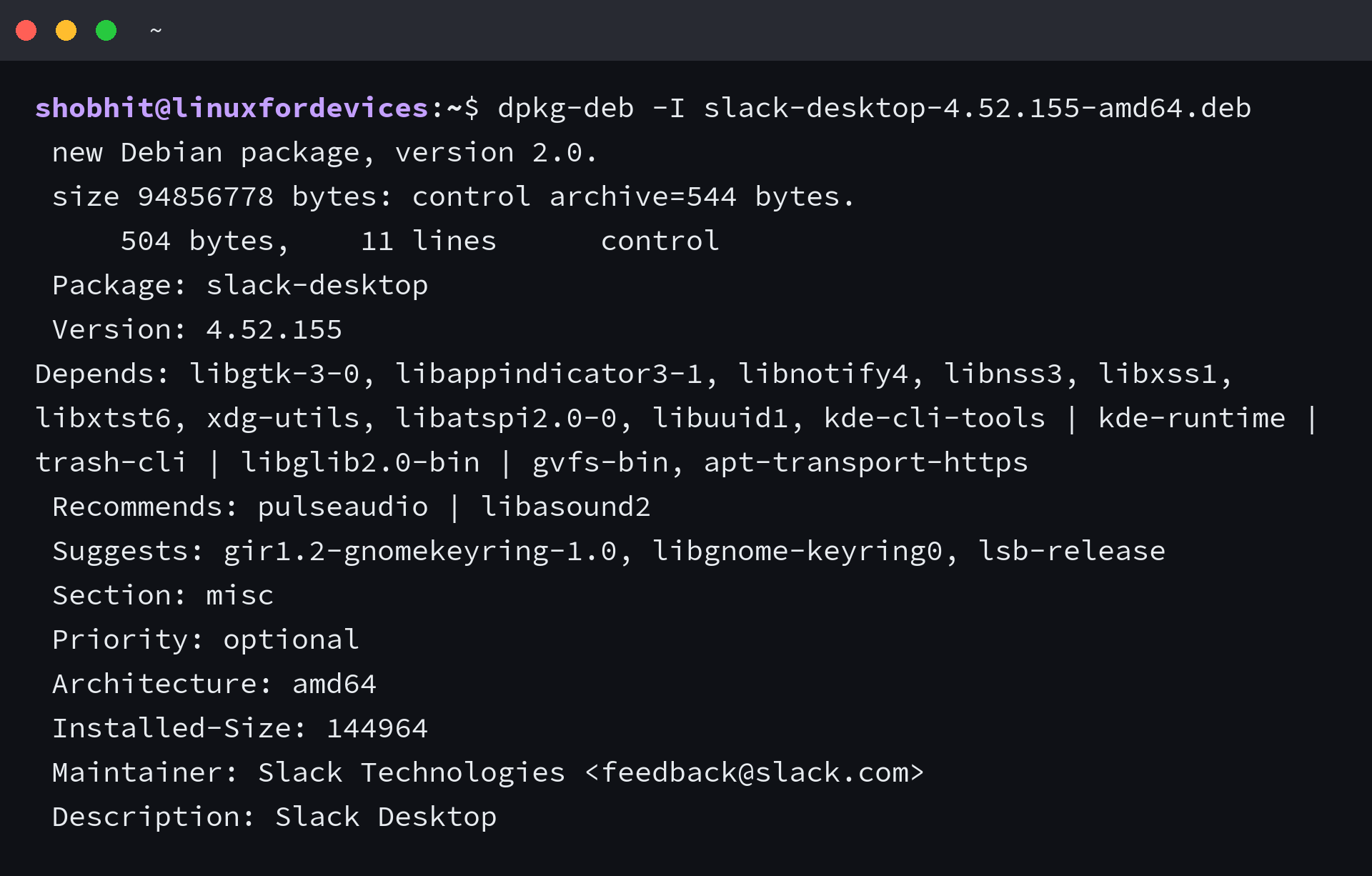
The architecture line says amd64, and the dependency list names libappindicator3-1, the library Debian renamed to libayatana-appindicator3-1 and some distributions no longer ship at all.
Install it through apt
apt resolves the dependency list when your archive lists are current, and dpkg does not, which is the division of labour between the two tools. Point apt at the local file.
sudo apt install ./slack-desktop-4.52.155-amd64.deb
Ask the binary what it is, then ask the package database what it recorded.
slack --version
dpkg -l slack-desktop
Let the package manage its own repository
Reading inside the .deb explains how updates reach you, so I pulled the cron script out of the package. It ships at /etc/cron.daily/slack, and its only output that matters is a repository line.
deb https://packagecloud.io/slacktechnologies/slack/debian/ jessie main
That is the jessie suite on purpose, and it is not a leftover from an old release. Slack’s repository serves one suite, so apt reads it whichever Ubuntu release you run. Adding it yourself skips the wait for the next cron run.
curl -fsSL https://packagecloud.io/slacktechnologies/slack/gpgkey | sudo gpg --dearmor -o /usr/share/keyrings/slacktechnologies_slack-archive-keyring.gpg
echo 'deb [signed-by=/usr/share/keyrings/slacktechnologies_slack-archive-keyring.gpg] https://packagecloud.io/slacktechnologies/slack/debian/ jessie main' | sudo tee /etc/apt/sources.list.d/slack.list
sudo apt update && sudo apt install slack-desktop
Packagecloud’s own setup script is the wrong tool here, and it fails in a way that reads like Slack pulled the package. It detects your distribution and writes a suite named after it, which this repository does not serve, so apt answers E: Unable to locate package slack-desktop. The three commands above are the working form.
Installing Slack on Fedora, RHEL and Rocky Linux
I found the RPM under the same versioned path as the .deb, with a different file name and a different installer.
wget https://downloads.slack-edge.com/desktop-releases/linux/x64/4.52.155/slack-4.52.155-0.1.el8.x86_64.rpm
sudo dnf install ./slack-4.52.155-0.1.el8.x86_64.rpm
The trap here is the shared path, since the .deb and the .rpm sit in the same directory. A command that fetches the wrong one hands a .deb to dnf, which cannot install it, and the error does not explain the mix-up.
Slack’s help centre adds one condition for the RHEL route, and it is where a fresh install stops. If the RPM repositories are not configured at all, start with enabling the Fedora repositories.
- The file name has to end in .rpm. The install stops when a .deb reaches dnf, and the error blames the package rather than the file.
- The system has to be registered with Red Hat Subscription Manager, otherwise dnf cannot resolve the GTK and NSS libraries.
Installing the snap, the Flatpak or the AUR build
These three cover the distributions Slack does not package for, and the choice between them comes down to how you want updates to arrive.
Snap
sudo snap install slack
The –classic flag that older guides show is gone from Slack’s own instructions, and the current channel map confirms a normal snapped app. If snapd is missing, the snap setup walkthrough covers the first install.
The snap and the .deb claim the same desktop entry, so pick one. Slack’s help centre says not to keep the snap and another Linux package installed at the same time, because the menu resolves whichever one it finds first.
Flatpak
flatpak install flathub com.slack.Slack
flatpak run com.slack.Slack
Flathub carries 4.52.155 as well, and flatpak update keeps it current. This is the route for Linux Mint, which ships Flatpak but not snapd, and for any distribution where you would rather not add a third-party apt suite. Where Flatpak is not configured yet, start with adding the Flathub remote.
Arch Linux and the AUR
Arch has no official package, so the AUR covers it.
yay -S slack-desktop
The AUR entry tracks the Slack build closely, at 4.52.155-1 on 5 September 2026, and it unpacks the same .deb Slack publishes.
| What you want | Which route | Why |
|---|---|---|
| Updates without thinking about them | Snap | Refreshes on its own schedule |
| A sandboxed app on Mint | Flatpak | Mint ships Flatpak and not snapd |
| The newest build on Arch | AUR slack-desktop | Follows Slack’s releases within days |
Starting Slack and signing in
Launch Slack from your application menu or by name from a terminal. Sign-in happens in the browser rather than in the app.

The window hands the workspace to your default browser and takes it back through the slack:// URL handler. When the browser asks you to click Open Slack and no such button appears, the handler is the missing piece rather than the app, and one command tells you whether it is registered.
xdg-mime query default x-scheme-handler/slack
On a Mint desktop the menu entry often needs the desktop file copying out of the snap directory, otherwise the launcher shows a generic icon:
cp /var/lib/snapd/desktop/applications/slack_slack.desktop ~/.local/share/applications/
When the install fails
Nearly every Slack install that stops halfway on Linux produces one of three errors. Each names its own cause, and none of them means the network dropped, including the one that reads like a damaged download and is not. In practice the first two come out of dpkg, and the last one appears when the app starts.
| What you see | What it means | What to run |
|---|---|---|
| dependency problems prevent configuration | dpkg unpacked the app without its libraries | sudo apt install ./slack-desktop-4.52.155-amd64.deb |
| trying to overwrite /usr/share/lintian/overrides/slack | Ubuntu’s own slack package owns that file | sudo apt remove slack |
| error while loading shared libraries | The app never configured, so the libraries are missing | sudo apt-get -f install |
dpkg stops with dependency problems
Installing the file directly with dpkg causes this, not a damaged download. I ran it against a clean Ubuntu 24.04 with no Slack dependencies installed, and dpkg unpacked the app and then refused to configure it because the libraries it needs were absent.
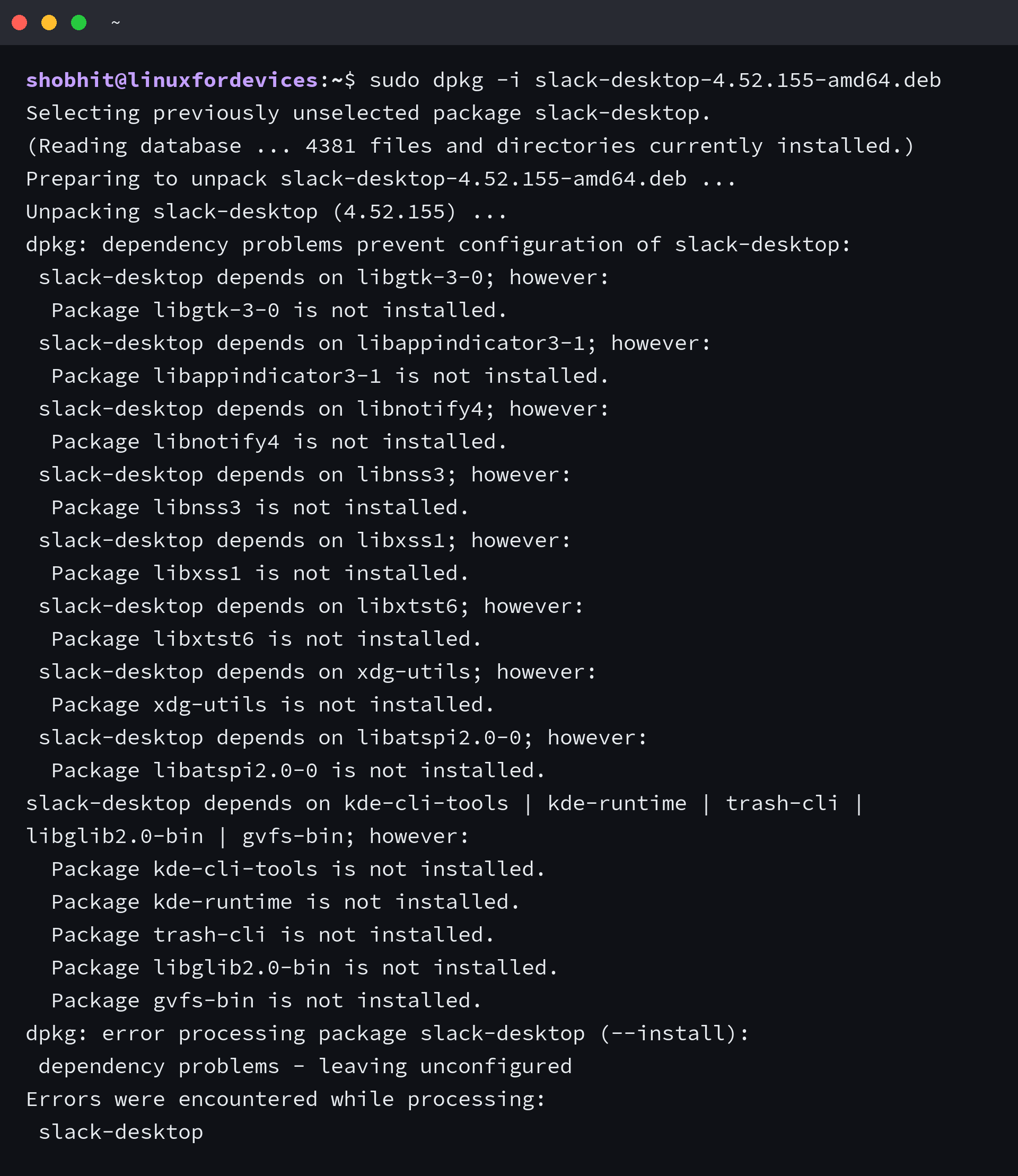
The repair is one command, and the local-file form is the better one because apt brings the dependencies with it. When dpkg has already left a package half-configured, the sub-process dpkg error walkthrough covers the general case.
sudo apt install ./slack-desktop-4.52.155-amd64.deb
The archive wants to overwrite a file owned by slack
The error names the file and the package holding it, and I reproduced it on the same clean container once Ubuntu’s own slack package was installed. dpkg stops before writing anything.
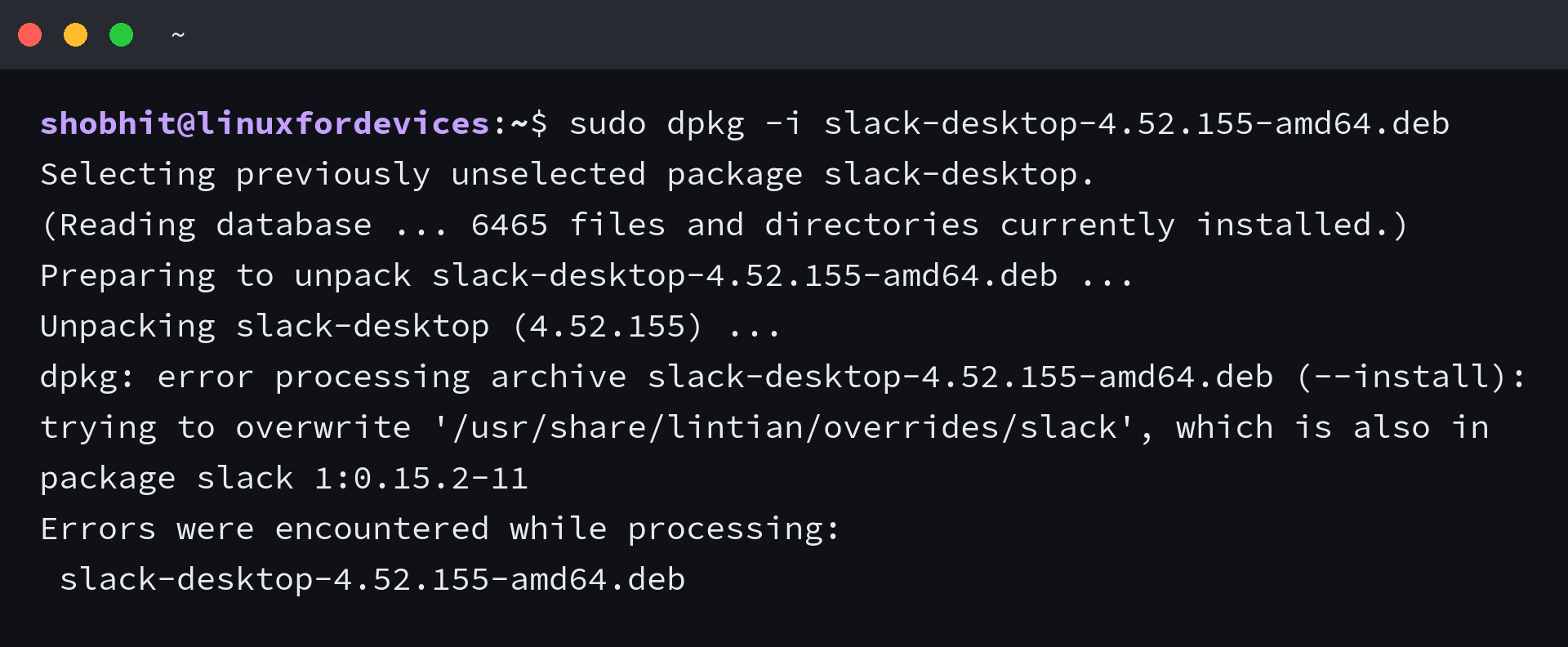
Remove the unrelated package and install again.
sudo apt remove slack
sudo apt install ./slack-desktop-4.52.155-amd64.deb
Slack starts and exits with a missing library
A message about libglib-2.0.so.0 or libgtk-3-0 means the app unpacked and never configured. Satisfy the dependency list the .deb declares, then configure it.
sudo apt-get -f install
slack --version
If Slack still exits, run it from a terminal and read what it prints. An Electron app that cannot open a display or an audio device writes the reason to the terminal it was launched from, and nothing to the menu you clicked.
Keeping the desktop app current
Every channel has one update command, and knowing which one applies saves a reinstall later.
sudo apt update && sudo apt upgrade slack-desktop
sudo snap refresh slack
flatpak update com.slack.Slack
Removal mirrors installation, and the .deb route leaves its repository file behind unless you delete it, which removing an apt repository on Ubuntu covers in full.
sudo apt remove slack-desktop && sudo rm /etc/apt/sources.list.d/slack.list
Frequently asked questions
How do I install Slack on Linux Mint?
Use the Flatpak build, because Linux Mint ships Flatpak but not snapd. The .deb works as well and adds Slack’s apt repository, so updates arrive through the Update Manager.
How do I install Slack on Arch Linux?
Install slack-desktop from the AUR. It tracks Slack’s current build, 4.52.155-1 as of 5 September 2026, and unpacks the same .deb that Slack publishes.
How do I install Slack on Kali Linux?
Kali inherits Debian’s package names, where libappindicator3-1 no longer exists under that name. The Flatpak install avoids the dependency entirely, and so does the snap.
Is there a Slack build for ARM64 Linux?
No. Slack publishes x86_64 packages only. The .deb, the .rpm, the snap channel map and the Flathub build are all limited to amd64 and x86_64 machines.
Does Slack have an official apt repository?
Yes. Slack’s apt repository serves one suite, jessie, on packagecloud, and the .deb you install writes that same repository line into apt through a daily cron job. You can add it by hand and skip the wait.
How do I uninstall Slack from Linux?
Remove it with the package manager that installed it. Use sudo apt remove slack-desktop, sudo snap remove slack or flatpak uninstall com.slack.Slack, and delete /etc/apt/sources.list.d/slack.list to drop the repository the .deb added.