

You can try Brave alongside your current browser and decide later whether to switch. It starts with its own bookmarks and settings, so you can set it up without changing your existing browser.
For the install itself, your Linux distribution is the starting point. Brave’s native package route lets your usual package manager handle its updates too.
Choose the Brave package for your Linux distribution
Use Brave’s native repository when your distribution appears in the official Linux instructions. The package manager can then install updates from the same source.
| Linux distribution | Package path |
|---|---|
| Debian, Ubuntu, Linux Mint | Brave’s signed APT repository |
| Fedora 41 or newer | Brave’s RPM repository with DNF5 |
| Fedora 40 or older, Rocky Linux, RHEL | Brave’s RPM repository with DNF |
| Fedora Atomic desktops | RPM repository with rpm-ostree |
| openSUSE | Brave’s RPM repository with Zypper |
| Arch Linux | Community-maintained AUR package |
Brave supports 64-bit AMD/Intel (amd64 or x86_64) and ARM (arm64 or aarch64) Linux systems. AUR and repackaged builds are community-maintained.
What you need before installing
Administrator access is needed to add repositories and install packages, so identify your distribution and architecture before running an install command.
cat /etc/os-release
uname -m
Together, these commands show your distribution and CPU architecture, which should be x86_64 or aarch64 for Brave’s listed Linux builds.
Install Brave from its official package source
Choose the section labeled for your release. A similar package manager name does not make commands interchangeable.
1. Use Brave’s install script
Brave’s installer detects the supported distribution and configures its package source. Running a downloaded script through a shell applies its changes immediately.
curl -fsS https://dl.brave.com/install.sh | sh
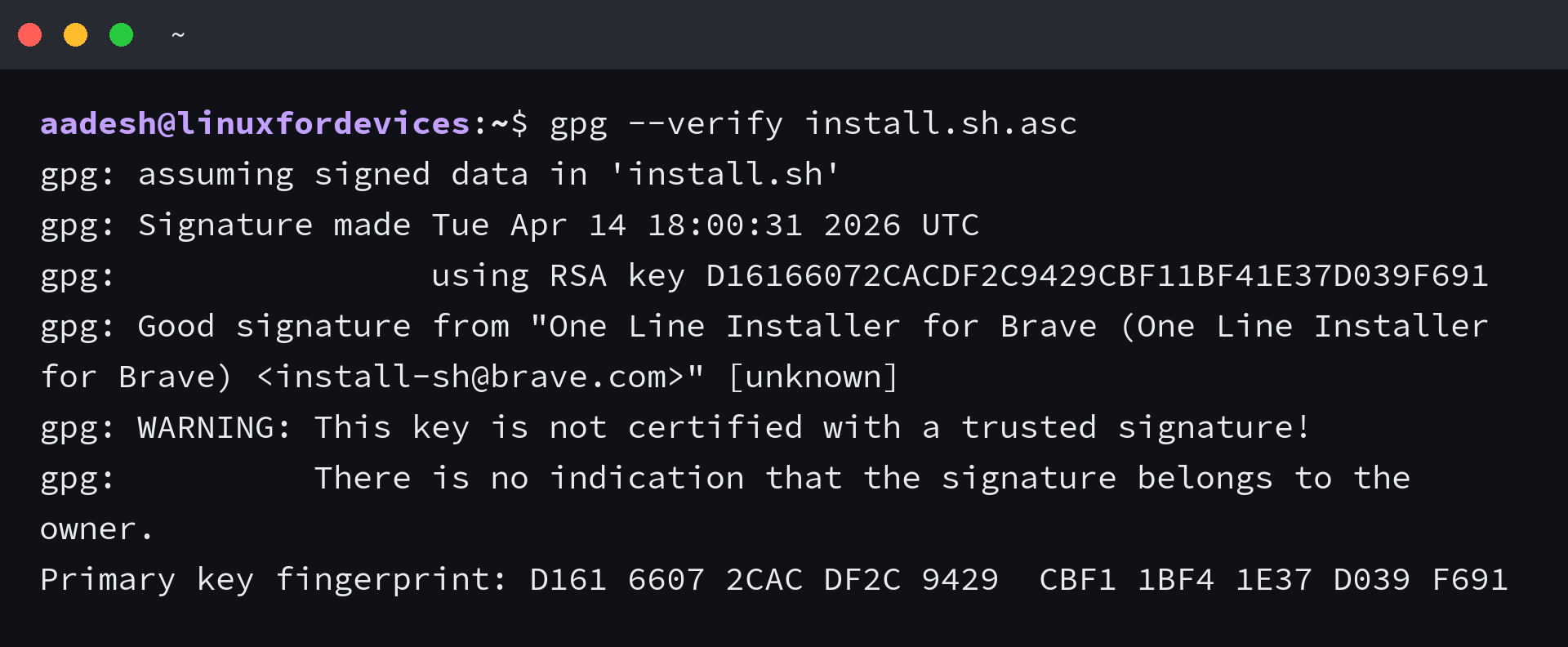
To inspect the signed installer instead, download both files and verify the detached signature with Brave’s published signing key.
curl -fsSLO "https://dl.brave.com/install.sh{,.asc}"
gpg --keyserver hkps://keys.openpgp.org --recv-keys D16166072CACDF2C9429CBF11BF41E37D039F691
gpg --verify install.sh.asc
Run the final command in the directory containing both downloaded files. GPG checks the script against its signature, but does not install Brave.
2. Debian, Ubuntu, and Linux Mint
Brave publishes a signed APT source and matching keyring. Add them before installing the brave-browser package.
sudo apt install curl

sudo curl -fsSLo /usr/share/keyrings/brave-browser-archive-keyring.gpg \
  https://brave-browser-apt-release.s3.brave.com/brave-browser-archive-keyring.gpg

sudo curl -fsSLo /etc/apt/sources.list.d/brave-browser-release.sources \
  https://brave-browser-apt-release.s3.brave.com/brave-browser.sources

sudo apt update
sudo apt install brave-browser
APT keeps the Brave package tied to the repository configured here. If you need the difference between installing a repository package and a downloaded package file, see our guide to installing DEB files on Ubuntu.
3. Fedora 41 and newer
Fedora 41 and later uses DNF5 with Brave’s RPM repository.
sudo dnf install dnf-plugins-core
sudo dnf config-manager addrepo \
  --from-repofile=https://brave-browser-rpm-release.s3.brave.com/brave-browser.repo
sudo dnf install brave-browser
4. Fedora 40 and older, Rocky Linux, and RHEL
These releases use the older DNF repository option. Use the add-repo form shown here. Fedora 41 and later uses the DNF5 command above.
sudo dnf install dnf-plugins-core
sudo dnf config-manager --add-repo \
  https://brave-browser-rpm-release.s3.brave.com/brave-browser.repo
sudo dnf install brave-browser


The first image shows the DNF plugin setup, and the second shows Brave being installed. Our RPM package installation guide explains how RPM differs from DEB packages.
5. Fedora Atomic desktops
Atomic desktops layer system packages with rpm-ostree. Add Brave’s repository file, install the package, and restart when the system asks you to boot into the new deployment.
run0 curl -fsSLo /etc/yum.repos.d/brave-browser.repo \
  https://brave-browser-rpm-release.s3.brave.com/brave-browser.repo
rpm-ostree install brave-browser
6. openSUSE
Add Brave’s RPM repository with Zypper, then install the package. Zypper records the source so later package operations use the configured repository.
sudo zypper addrepo https://brave-browser-rpm-release.s3.brave.com/brave-browser.repo
sudo zypper install brave-browser
7. Arch Linux
Brave’s Linux page points Arch users to the AUR and names helpers such as yay, paru, and pikaur. The AUR package is community-maintained, not a Brave-hosted repository. See our Pacman guide for the separate package-manager background.
yay -Sy brave-bin
Review the build instructions for brave-bin before installing this community-maintained package. Our AppImage guide covers a separate bundle format.
Launch, update, or remove Brave
The package manager that installed Brave handles its later updates and removal. Use that source for the commands below.
| Install source | Update | Remove |
|---|---|---|
| APT | sudo apt update, then sudo apt install –only-upgrade brave-browser | sudo apt remove brave-browser |
| DNF | sudo dnf upgrade brave-browser | sudo dnf remove brave-browser |
| Zypper | sudo zypper update brave-browser | sudo zypper remove brave-browser |
| AUR with yay | yay -Syu brave-bin | yay -R brave-bin |
For Fedora Atomic, install updates through rpm-ostree and reboot into the updated deployment. Snap and Flatpak updates use their own tools, so check the source you selected rather than mixing commands from this table.
APT’s remove command leaves configuration files behind. If you need to remove those too, follow our guide to removing Ubuntu packages and choose its purge instructions.
Launch a repository-installed copy from your desktop’s app menu or run brave-browser in a terminal. The Snap package uses brave, and the Flathub package ID is com.brave.Browser.
When installation fails
If the package manager cannot find brave-browser, refresh its package index and check that the Brave repository file was added to the correct directory. The Debian-family source uses a .sources file and a keyring under /usr/share/keyrings.
- Confirm the distribution and release with cat /etc/os-release.
- Check the architecture with uname -m. Brave lists amd64/x86_64 and arm64/aarch64.
- Use the DNF5 repository command only on Fedora 41 and newer. Older Fedora and RHEL-family systems use the previous DNF form.
On Fedora 41 and later, use DNF5’s addrepo –from-repofile form. Older Fedora and RHEL-family releases use config-manager –add-repo. Mixing the two forms can leave the repository unconfigured.
Brave lists 64-bit AMD/Intel and ARM builds. If uname -m prints a different architecture, the official Linux page does not list that machine as supported.
Keep Brave on its supported update path
After installation, keep using the package source you chose. For a native repository install, check the browser version with the same executable you use to launch it.
brave-browser --version
Frequently asked questions
Does Brave work on Linux Mint?
Yes. Brave lists Linux Mint with Debian and Ubuntu for its signed APT repository installation.
How do I update Brave on Linux?
Update Brave with the package manager for its installation source. For an APT install, run sudo apt update and sudo apt install –only-upgrade brave-browser.
Can I install Brave with Flatpak or Snap?
Yes. Brave is listed on Flathub and Snapcraft. Brave recommends its official native package repositories when your distribution supports them.