
Wayland’s fractional scaling keeps the desktop sharp on a HiDPI screen, but Steam and the games it launches often get a completely different picture. A monitor set to 150% or 200% scaling gets reported to games as a smaller, lower-resolution display, so a title like Portal 2 or a Proton game such as Rocket League ends up rendering at a fraction of its real size.
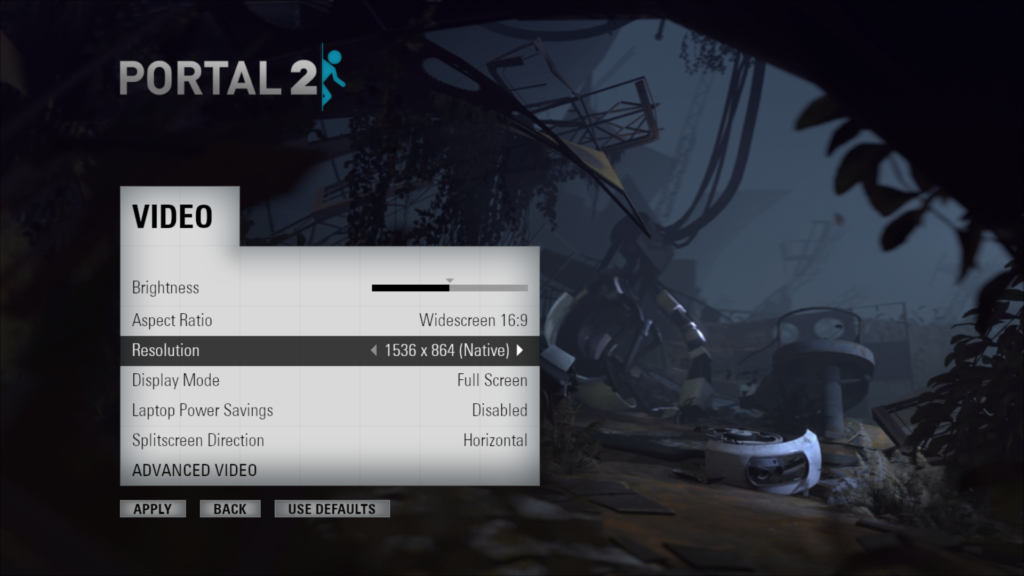
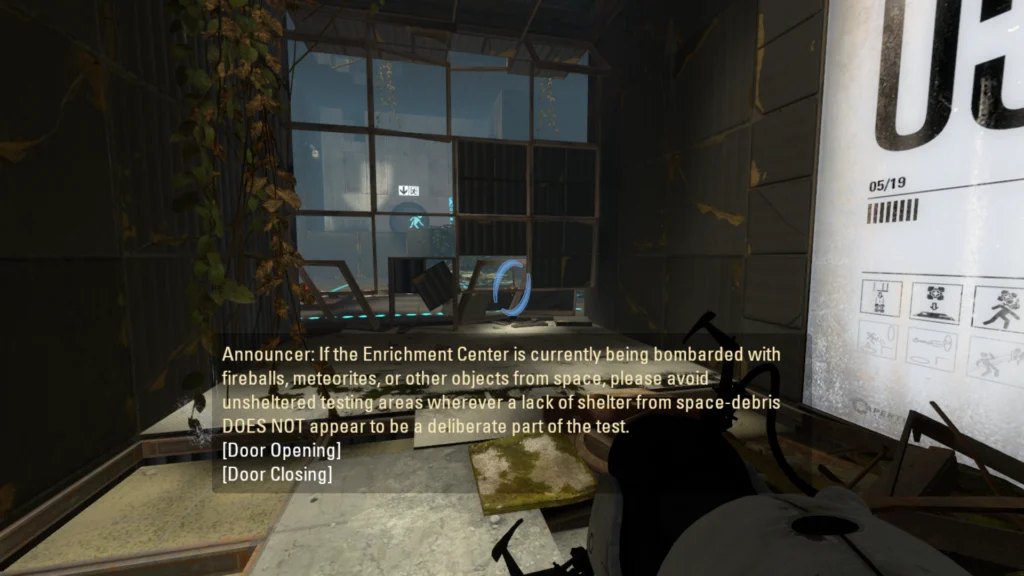
For example, as you can see in the screenshot of Portal 2 below, my 1920×1080 monitor is being recognized as 1536×864 resolution (with the correct aspect ratio).
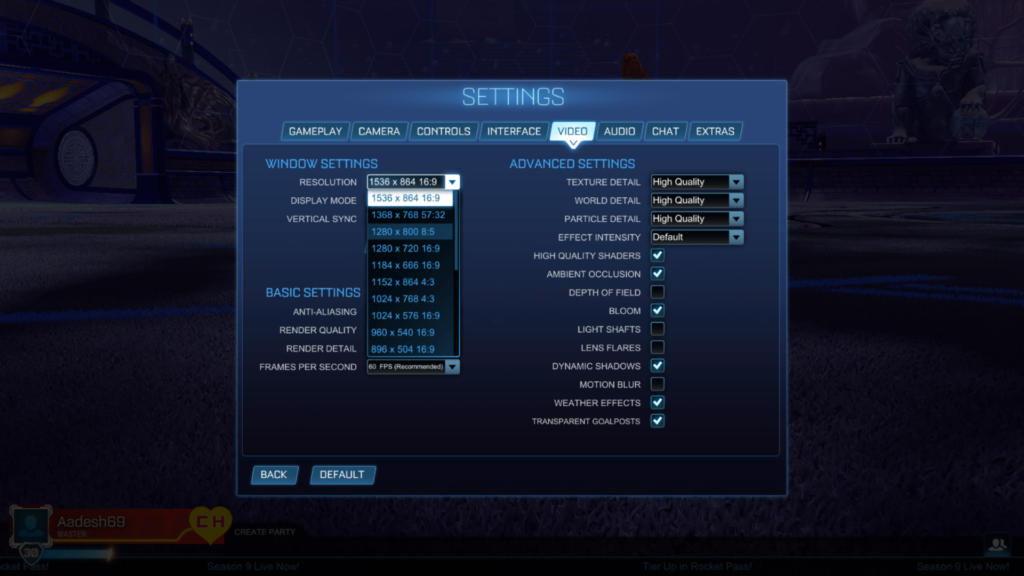
And this issue persists with non-native Linux games as well, which use Proton or Proton-GE to run on Linux (such as Rocket League).
This guide covers why Steam Wayland scaling breaks this way and the fixes that actually hold up, from gamescope to a couple of desktop settings.
Why Steam games misread the Wayland scaling setting
Wayland reports two sizes for a display: the physical mode the panel runs at, and a smaller logical size once scaling is applied. Set a 4K monitor to 200% and games see it as a 1920×1080 screen, since most games ask for supported resolutions and only get the scaled-down list back.
Steam makes this worse because it and most of the games it launches run through XWayland, which doesn’t get proper per-app scaling. That’s also why toggling “Scale text and icons to match monitor settings” in Steam’s own settings does nothing for the games it starts.
Fix Steam games with gamescope
The most reliable fix is gamescope, Valve’s own micro-compositor. It runs its own small Wayland session scoped to a single game, and it presents whatever resolution you tell it to regardless of what the host compositor’s scale factor is doing. It’s the same tool that runs every game on the Steam Deck, so this is the fix Valve’s own engineers lean on.
Install gamescope
Most distros package it directly:
sudo pacman -S gamescope
sudo apt install gamescope
sudo dnf install gamescope
Set the launch option
Right-click the game in your library, open Properties, and add this to Launch Options:
gamescope -W 3840 -H 2160 -r 120 -f --force-grab-cursor -- %command%
-W and -H set the real output resolution, -r caps the refresh rate to match your panel, -f runs fullscreen, and --force-grab-cursor keeps the mouse inside the game window, which helps in shooters. Launch the game and the correct resolution should show up in its own graphics settings.
Keeping it working while streaming
If your monitor’s live resolution changes often, such as when connecting to a TV or streaming with Sunshine and Moonlight, a small wrapper script can read the current mode with kscreen-doctor and pass those numbers to gamescope automatically, so the same launch line keeps working at the desk and over a stream.
A note for Flatpak Steam users
If Steam itself is installed as a Flatpak, install the matching gamescope Flatpak (org.freedesktop.Platform.VulkanLayer.gamescope alongside the gamescope app itself) rather than a distro package, since a Flatpak Steam usually can’t see gamescope binaries installed outside its sandbox.
Turn off system scaling for legacy X11 apps on KDE
KDE Plasma on Wayland lets you choose, separately, whether X11 (XWayland) apps get scaled by the system or scale themselves. If it’s set to system scaling, Steam and most of what it launches inherit the same logical-resolution problem described above. Switching that one setting fixed it for at least one Fedora KDE user running 150% scaling on a 4K panel.
Where to change it
Open System Settings, go to Display and Monitor, then the scaling section, and change legacy X11 applications from “scaled by the system” to “apply scaling by themselves.” Games launched through Steam should now correctly see the real panel resolution.
The trade-off is that other XWayland apps that don’t handle their own scaling well may end up looking small, so it’s worth testing before you commit to it as your default.
Editing config files directly
If you’d rather edit KDE’s config files directly instead of digging through the settings UI, the general guide to editing Linux config files covers the safe way to do that, including how to back up a file before you touch it.
GNOME doesn’t offer an equivalent per-app toggle for legacy X11 applications, so this particular fix is KDE-only. GNOME users dealing with the same problem should reach for gamescope or a custom launch option instead.
Add custom launch options in Steam
You can also force Steam or other launchers to launch games in a custom resolution by adding launch options. This isn’t a real fix, since the game still processes at the resolution you set and then gets stretched or letterboxed to fill the screen, which can cause blur.
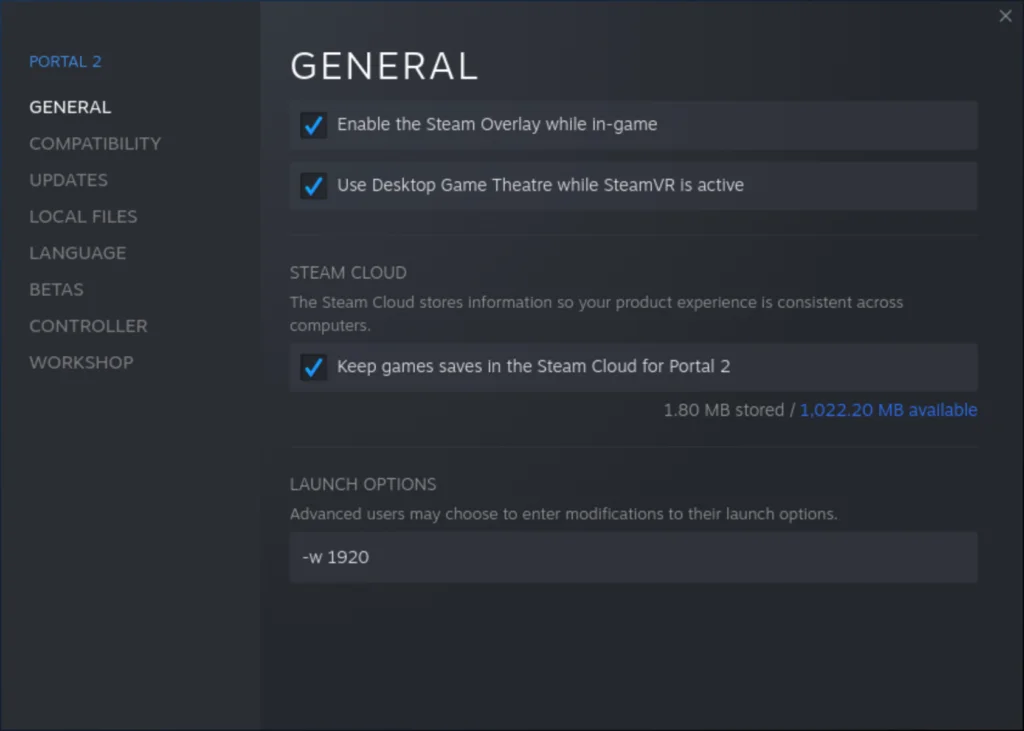
It’s still a useful fallback when gamescope isn’t installed. Add the following launch option to a game from its properties section on Steam:
-w 1920
Matching the option to your resolution
If you have a monitor with a different resolution, use one of the values below instead:
| Launch option | Resolution |
|---|---|
| -w 640 | (640×480) |
| -w 720 | (720×576) |
| -w 800 | (800×600) |
| -w 1024 | (1024×768) |
| -w 1152 | (1152×864) |
| -w 1280 | (1280×1024) |
| -w 1600 | (1600×1200) |
| -w 1768 | (1768 x 992) |
| -w 1920 | (1920 x 1080) |
| -w 2560 | (2560 x 1440) |
Other places to store these launch options
You can find the full list of supported launch option flags on Valve’s own support page. If you juggle several games with different fixes, a launcher like Lutris can also store these options per game so you don’t have to re-enter them by hand, and it’s worth a look if you’re already setting up other games on Linux alongside Steam.
Switch to an X11 session as a last resort
Because this is fundamentally a Wayland problem, you can sidestep it entirely by logging into an X11 (Xorg) session instead. Save your work, log out, and pick “X11” or “Xorg” on your login screen, available on GNOME, KDE and most other desktop environments.
X11 doesn’t support fractional scaling, so icons and text on a HiDPI panel may look small or blurry once you’re on it. Games launched under X11 do see your monitor’s actual resolution though, and run correctly.
Fix Steam’s own interface scaling on Wayland
Separately from in-game resolution, Steam’s own client window can also fail to scale under Wayland, showing tiny text and icons on a 4K panel even with “Scale text and icons to match monitor settings” enabled. This has been an open issue since around February 2023, and there’s still no built-in fix from Valve.
The workaround is to force the scale factor directly: add -forcedesktopscaling 2 (use 1.5 for 150% scaling, and so on) to the Steam shortcut or desktop file you launch from. This overrides whatever the compositor is reporting.
What’s coming: Wine and Proton are getting native Wayland scaling
The root cause here is that Steam and most Windows games still reach Linux through XWayland rather than as native Wayland clients. That’s starting to change. In June 2026, a Wine developer merged code that adds fractional scaling support to Wine’s native Wayland driver, landing in the Wine 11.12 release around June 26.
What the Wine change actually fixes
The change lets Wine render at the DPI set in winecfg while keeping windows crisp on Wayland, matching how XWayland already handles a single display, and doing better than XWayland once several monitors run at different fractional scales. It arrived alongside a related fix to a Mutter fractional-scaling bug, so GNOME users benefit as well as KDE ones.
What this means for Proton
Since Valve’s Proton is forked from Wine, this points toward a future where Proton titles inherit proper native Wayland scaling instead of depending on the XWayland compatibility path this guide is working around. It won’t help today’s games immediately, but it’s the direction the whole stack is moving.
If you manage multiple Proton builds already, a tool like ProtonPlus makes it easy to grab new versions as this support rolls out, and Valve continues shipping regular Proton point releases in the meantime.
Key takeaways
- Wayland reports a scaled-down logical resolution to apps, not the panel’s real physical mode
- Steam and most games still run through XWayland, which doesn’t get proper per-app fractional scaling
- gamescope is the most reliable fix and is the same tool the Steam Deck uses
- KDE users can also fix this by scaling legacy X11 apps themselves instead of system-wide
- Custom launch options and switching to X11 both work but come with visible trade-offs
- Steam’s own interface scaling is a separate bug, fixed with the -forcedesktopscaling launch flag
- Wine 11.12 adds native Wayland fractional scaling, which should eventually reach Proton too
Frequently asked questions
Why does my game only show 1080p options on a 4K Wayland desktop?
Wayland reports the compositor’s scaled logical resolution to apps, not the physical mode, so a 4K panel at 200% scaling looks like 1080p to games that ask for supported resolutions.
Does gamescope work on GNOME as well as KDE?
Yes. gamescope runs its own compositor session and doesn’t depend on the desktop environment hosting it, so the same launch option works on GNOME, Hyprland or sway.
Will switching to X11 fix game resolution on Wayland?
Yes, since X11 doesn’t apply Wayland’s fractional scaling to begin with, but icons and text may look small or blurry on a HiDPI screen once you’re back on X11.
Why doesn’t Steam’s “scale text and icons” setting do anything on Wayland?
Steam’s client mostly runs through XWayland, which doesn’t receive Wayland’s native per-app scaling signal, so that toggle has no effect until you force a scale factor manually.
Is there a permanent fix coming for this Wayland scaling issue?
Wine merged native Wayland fractional scaling support for its 11.12 release in June 2026, and since Proton forks from Wine, that support should eventually carry over to Steam’s Windows games.
Do I need to reinstall gamescope for every game I want to fix?
No, you only need to install it once system-wide, since it’s a compositor, not a per-game plugin. You add the gamescope launch option separately to each game’s Properties in Steam.
Does this same scaling bug affect non-Steam games too?
Yes. Any game launched outside gamescope through XWayland can misread the logical resolution the same way, whether it comes from Lutris, Heroic, or a native Linux binary.
Does the Steam Deck have this problem too?
No. SteamOS runs gamescope as the default session for every game, so the Steam Deck’s built-in screen and any external display it’s connected to already get the correct resolution without any manual setup on your part.
Conclusion
Scaling on Wayland is still catching up in places, but between gamescope, the KDE scaling toggle and the upstream Wine work, Steam Wayland scaling is a lot less painful to deal with today than it was when this issue first showed up back in 2023, and it should keep getting better as Proton picks up Wine’s native Wayland support in the releases ahead.