
A machine set to UTC may show a different local time than you expect. Its timezone applies regional rules to the system clock to produce local date and time.
This article explains how to find a zone name and change the Linux timezone with timedatectl.
TL;DR: Change the Linux timezone
Use timedatectl to choose an IANA timezone identifier, then check the system status to confirm the change.
timedatectl list-timezones | grep -i 'new_york'
sudo timedatectl set-timezone America/New_York
timedatectl
The first command filters for matching zone names, the second applies your chosen Region/City value, and the final command reports the resulting system status.
What is a Linux timezone?
A timezone is a set of rules that converts the system clock into local date and time. Linux commonly identifies those rules with an IANA name such as America/New_York or Europe/Paris.
The system timezone controls the default local time used by programs and displayed by commands such as date, while NTP keeps the system clock synchronized.
On a system using systemd, timedatectl manages the setting and updates /etc/localtime to point to the selected rules. This is the preferred route because it uses the system’s timezone service rather than manually changing its files.
The zone database includes local rules and changes to UTC offset over time, including seasonal clock changes where applicable.
How to change the timezone in Linux step by step
Run these steps in a terminal on a system that uses systemd. Keep the current zone handy so you can compare it after the change.
Step 1: Check the current timezone
Run timedatectl without a subcommand to display the local zone and related clock status.
timedatectl
For example, the read-only check here returned the following status:
Local time: Sat 2026-10-17 21:53:45 UTC
Universal time: Sat 2026-10-17 21:53:45 UTC
RTC time: Sat 2026-10-17 21:53:46
Time zone: Etc/UTC (UTC, +0000)
System clock synchronized: yes
NTP service: active
RTC in local TZ: no
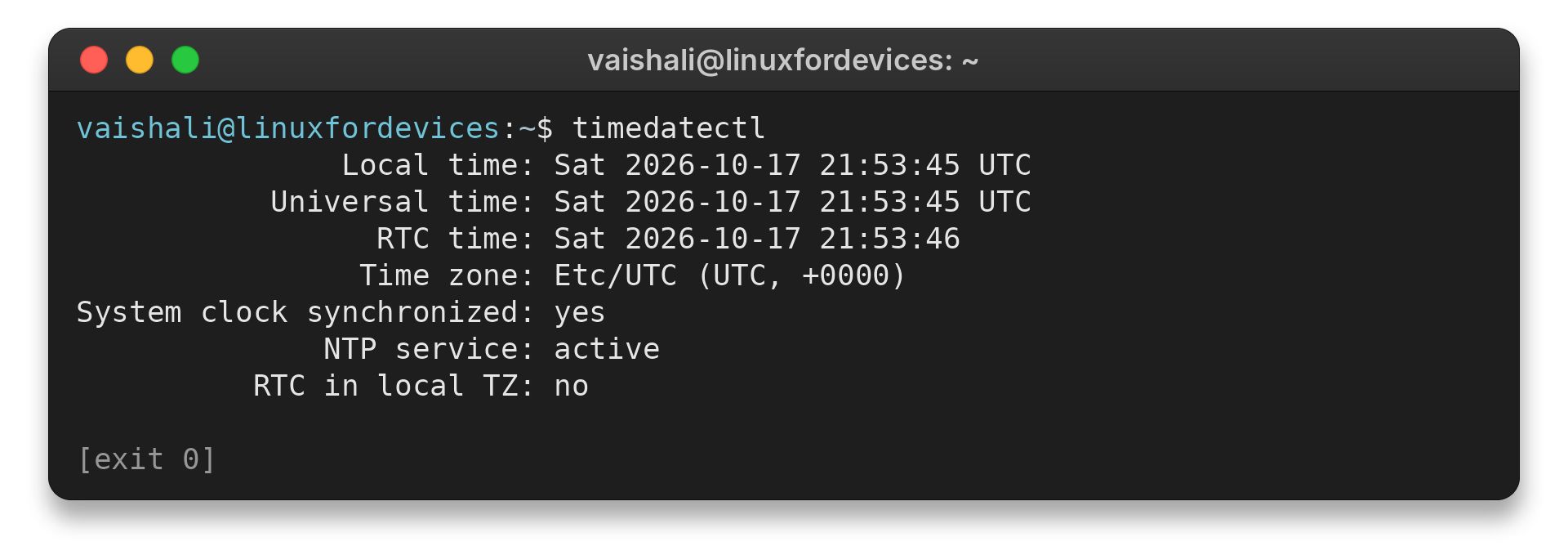
The Time zone field identifies the active zone. NTP status is reported separately, so it can be checked without confusing it with the timezone.
Step 2: Find the right zone name
Choose the full identifier shown in the list. It names a region and place, such as America/New_York.
timedatectl list-timezones
timedatectl list-timezones | grep -i 'new_york'
The filtered result should be a full identifier, for example America/New_York. Use that exact spelling when setting the zone.
Step 3: Set the system timezone
Pass the chosen identifier to timedatectl set-timezone. Changing the system-wide setting requires administrator privileges, so sudo prompts for authorization when your account is allowed to administer the machine.
sudo timedatectl set-timezone America/New_York
Replace the example with the identifier found in the previous step. Administrator authorization allows timedatectl to update the system-wide setting.
Step 4: Verify the change
Read the status again and compare the Time zone line with your selection. You can also ask date to display the current local abbreviation and offset.
timedatectl
date '+%Z %z'
The timezone name should match the selection, and date shows its current abbreviation and UTC offset.
What should you check after changing the timezone?
If the setting does not change, first check whether timedatectl is available and whether you have administrator access. The fix depends on whether the system uses systemd, whether you intend to change one application or the whole machine, and whether the actual clock is synchronized.
| Situation | What to do |
|---|---|
| timedatectl is missing | Use the distribution’s timezone tool, such as dpkg-reconfigure tzdata on Debian or Ubuntu, or follow its systemd-free instructions. |
| Only one command needs another zone | Set TZ for that process rather than changing the machine-wide setting. |
| The displayed time is still wrong | Check clock synchronization separately with timedatectl status. |
| A server’s logs need a common reference | Choose Etc/UTC, then verify how the application formats its own timestamps. |
On a system without systemd, timezone files commonly live under /usr/share/zoneinfo and /etc/localtime identifies the active rules. Follow the distribution’s documented method rather than deleting that path blindly: it may be a file or a symbolic link, and replacing it incorrectly can leave the machine without a valid timezone.
Debian and Ubuntu provide the tzdata configuration tool for selecting a zone when timedatectl is unavailable. A text-based menu can present the region and location choices, after which the distribution updates its timezone configuration. Check the installed system’s manual for the exact invocation because options differ by package version.
On a server, Etc/UTC is a common choice when logs and scheduled tasks need a consistent reference across locations. Local-time display can still be applied by a reporting application, so check how that software formats timestamps before changing a machine shared by several services.
For a single process, TZ=Etc/UTC command applies the override only to that command. GNU date also honors TZ, while other applications may have their own timezone settings. For related administration tasks, see our guide to setting the timezone on Ubuntu and the Ubuntu time synchronization guide.
Conclusion: Set the zone, then verify it
Set the system timezone with a full Region/City identifier, then check the result with timedatectl. Consult the systemd timedatectl manual for command details and the Ubuntu links above for distribution-specific guidance.
FAQ
These answers cover common timezone choices on Linux.
How do I set Linux to UTC?
Run timedatectl list-timezones to confirm Etc/UTC is available, then use sudo timedatectl set-timezone Etc/UTC and verify with timedatectl.
Does changing the timezone change the system clock?
No. It changes how the clock is converted to local time. NTP synchronization controls whether the clock is kept in step with a time source.
Can I change the timezone without timedatectl?
Yes. Use the timezone configuration tool documented for your distribution. Debian and Ubuntu provide dpkg-reconfigure tzdata; systems without systemd may use their documented /etc/localtime method.