
TradingView for Linux is available as an official Debian package and an official Snap. Use the Debian package on a 64-bit Ubuntu, Linux Mint, or another Debian-based desktop. Choose Snap when your distribution supports snapd, but use X11 or XWayland because TradingView reports that its Snap build is unstable on native Wayland.
Check whether your Linux system is supported
TradingView supports 64-bit Intel and AMD processors. Its tested Linux releases are Ubuntu 20.04 LTS, 22.04 LTS, and 24.04 LTS, while other distributions may work when they support Debian or Snap packages. Review how package management on Linux differs across distributions before you choose a format.
Run the following command before downloading anything. An x86_64 result meets the processor requirement, while aarch64 or arm64 does not.
uname -m
The current Debian package I downloaded from TradingView identifies version 3.3.0-1 and architecture amd64. TradingView also publishes version 3.3.0 in the stable Snap channel, so both official routes target the same desktop release.
| Your system | Choose | Reason |
|---|---|---|
| Ubuntu, Linux Mint, Debian, or another 64-bit Debian-based desktop | Debian package | It installs through APT and avoids the Snap build’s native Wayland limitation. |
| A 64-bit distribution with working snapd | Snap package | It gives you one cross-distribution command and automatic Snap refreshes. |
| ARM64 or AArch64 Linux | Browser version | TradingView Desktop is not published for ARM processors. |
| Native Wayland session | Debian package or XWayland | TradingView marks the Snap build as unstable on native Wayland. |
If you only need one chart in a browser tab, the web app avoids package and display-server constraints. Install the desktop app when separate windows, multiple monitors, or a dedicated chart workspace improve your setup. Our Snap and Debian package walkthrough shows how the same packaging choice affects another desktop application.
Install TradingView with the Debian package
TradingView recommends the Debian route for 64-bit Debian-based distributions. The repository commands below install the archive key, add the vendor repository, refresh APT metadata, and install the tradingview package.
- Open a terminal on your Debian-based desktop.
- Add the TradingView archive key and repository with the commands below.
- Refresh the package index, then install TradingView.
- Launch TradingView from your application menu and sign in.
wget -O - https://tvd-packages.tradingview.com/keyring.gpg | sudo tee /usr/share/keyrings/tradingview-desktop-archive-keyring.gpg >/dev/null
The signed-by option limits this repository entry to TradingView’s archive key rather than trusting that key for every APT source. If wget is unfamiliar, check the wget command options before you download a key through a shell pipeline.
echo "deb [arch=amd64 signed-by=/usr/share/keyrings/tradingview-desktop-archive-keyring.gpg] https://tvd-packages.tradingview.com/ubuntu/stable jammy multiverse" | sudo tee /etc/apt/sources.list.d/tradingview-desktop.list >/dev/null
sudo apt update
sudo apt install tradingview
APT should finish without an unresolved dependency message. If dpkg stops the transaction, use the dpkg error recovery steps before you retry. Open TradingView from the desktop application menu, then wait for the chart workspace to load before treating the installation as complete.
Install a downloaded Debian package instead
The official TradingView Desktop download page also provides the current Debian file. Download it, open your Downloads directory in a terminal, and let APT install the local package with its dependencies. Use the Linux command-line navigation guide if you need help moving into Downloads.
cd ~/Downloads
sudo apt install ./tradingview_amd64.deb
Use the exact filename shown in your Downloads directory if the browser renamed it. The package is proprietary and built for amd64, so do not force it onto an ARM system.
Install TradingView with Snap
Snap is the practical alternative when your distribution is not Debian-based but supports snapd. Confirm snapd first, then use the stable package name published by TradingView. On Ubuntu, GNOME Software can manage package sources when you prefer a graphical installer.
snap version
A version table confirms that the Snap client and service are available. If the shell reports that snap is missing, install snapd through your distribution’s package manager before continuing.
On Nobara and other Fedora-based distributions, DNF presents the snapd transaction before it changes the system. Review the package list and disk use, then confirm the prompt.
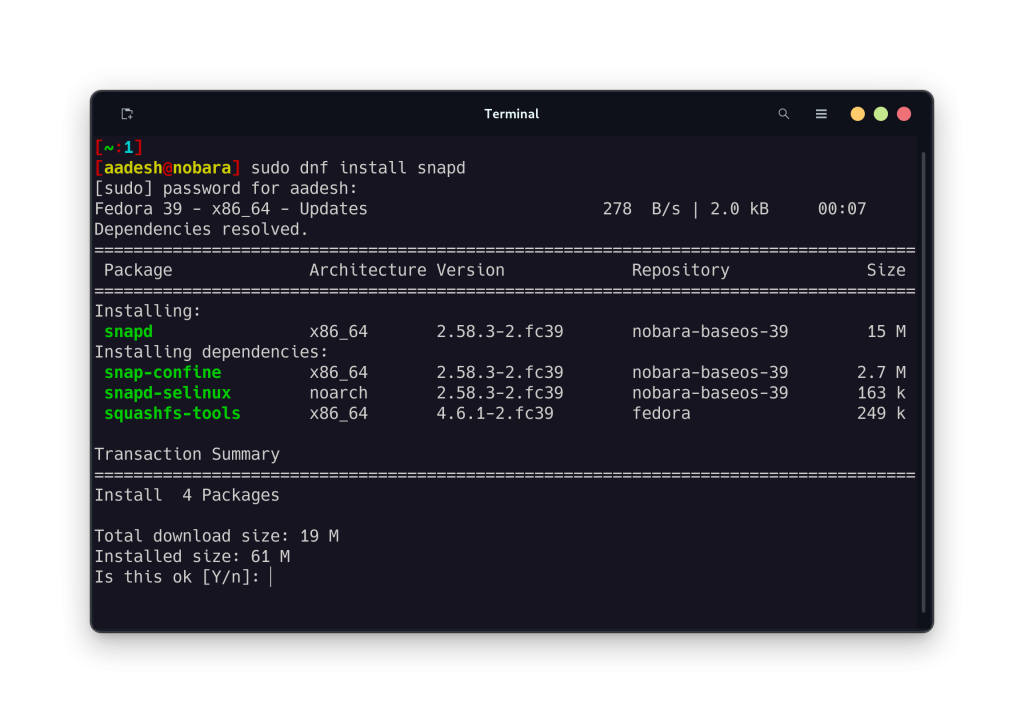
The screenshot stops at the confirmation prompt. Finish that transaction, create the /snap link when your distribution requires it, and start a new login session so desktop launchers can see Snap applications.
sudo ln -s /var/lib/snapd/snap /snap
Skip the symbolic-link command when /snap already exists. Then install the stable TradingView package.
sudo snap install tradingview
Snap displays download progress before it prints the installed release, so keep the terminal open while the transfer is running.
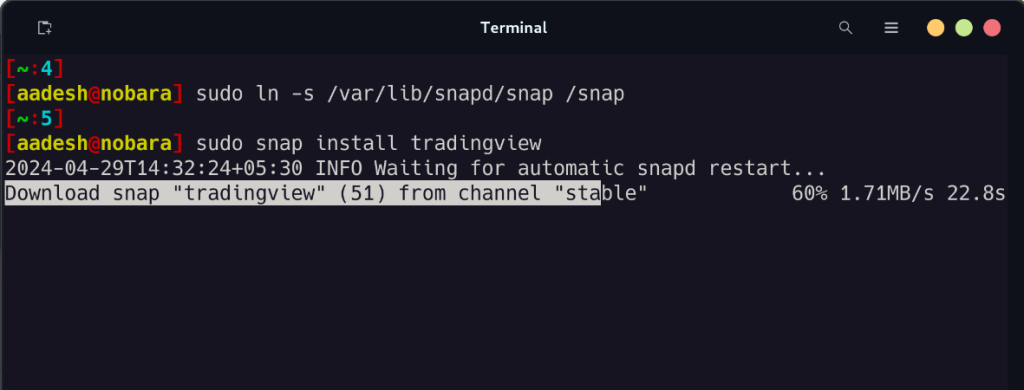
Wait for the final success line before you open TradingView from the application menu or run tradingview from a terminal.
Verify TradingView after installation
A successful package transaction is only the first check, so launch the app, sign in, and confirm that a chart plus your watchlist loads without a blank window or network error.
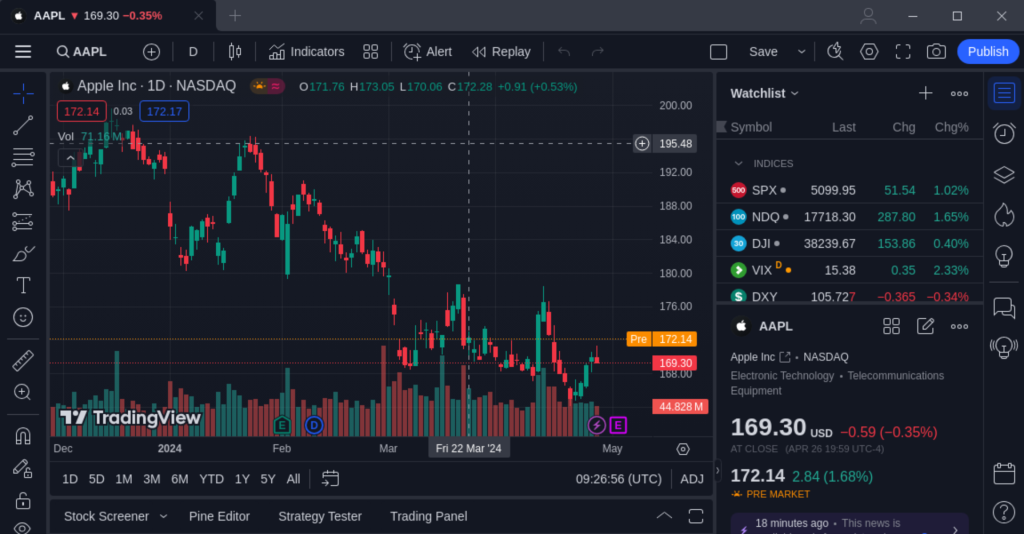
The loaded AAPL chart, watchlist, drawing controls, and status values show that the desktop client can render its main workspace. If you use several monitors, move one chart window to another display and reopen the app to confirm that the desktop workflow suits you better than the browser.
Use the desktop features that justify the install
The desktop client exposes the same charting workspace through a dedicated application window. The indicators dialog is the fastest check that studies and search are available after sign-in.
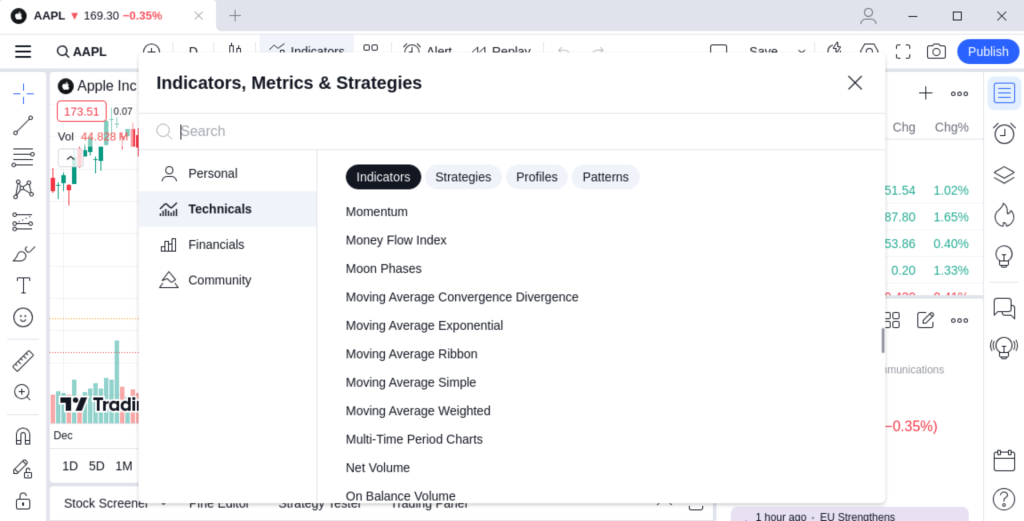
Choose an indicator only after checking its inputs and the market data behind the chart. Adding several studies can make the view harder to interpret without improving the decision.
The chart-layout selector arranges several views inside one workspace. Pick a layout that matches the number of symbols or timeframes you need rather than filling every slot.
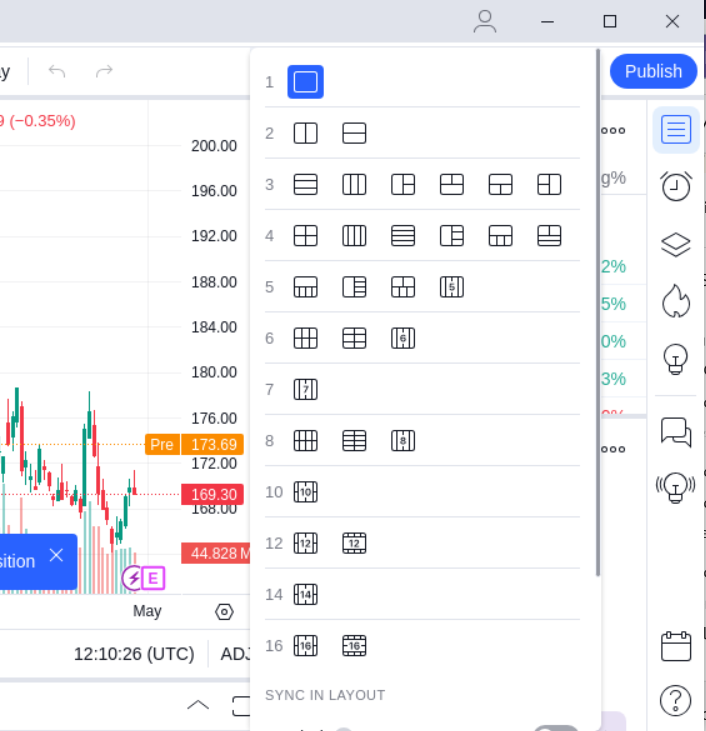
Start with one or two panes, confirm that symbol and interval changes affect the intended chart, then expand the layout. This keeps linked charts from changing together when you expected separate instruments.
TradingView also places public discussions and private messages beside the chart workspace. Treat community posts as conversation, not as verified market guidance.
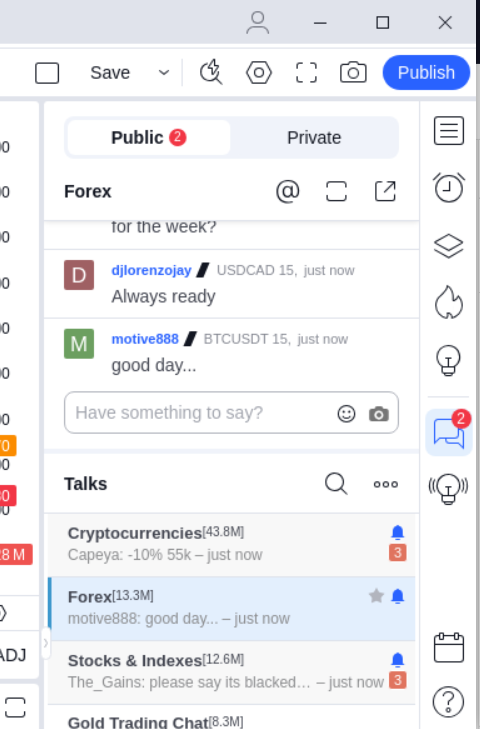
The Public and Private tabs separate room messages from direct conversations, while your financial decisions should stay tied to your own analysis and risk controls outside the chat panel.
Update or remove TradingView
The update command depends on the package route because APT refreshes TradingView from its repository, while Snap refreshes the installed snap from its channel.
Update the Debian package
sudo apt update
sudo apt --only-upgrade install tradingview
If APT reports that TradingView is already the newest version, no package change is needed, but a repeatedly failing update calls for removal and a clean install from the current official repository instructions.
Update the Snap package
sudo snap refresh tradingview
Snap normally refreshes applications automatically, while the manual command checks for the current stable release immediately.
Remove the app
sudo apt remove tradingview
Use the APT command only for a Debian installation and remove the snap instead when you chose the Snap route.
sudo snap remove tradingview
Removing the package does not change account or data-retention controls on TradingView’s website, so review those settings before you close an account or handle saved chart data.
Fix common TradingView problems on Linux
Match the symptom to the package, processor, display server, or connection before you reinstall the app. Each check below changes a different part of the startup path.
The Snap opens a blank window or fails under Wayland
TradingView says its Snap build is unstable on native Wayland, so log in with an X11 session, force the application through XWayland, or replace the Snap with the official Debian package on a supported Debian-based system.
The package is unavailable for your processor
TradingView Desktop supports amd64 processors rather than ARM, which makes the browser version the supported choice for an ARM laptop or single-board computer.
APT cannot verify or locate the TradingView package
Recheck the archive-key command, the repository file, and the output from sudo apt update. A repository signature error needs a corrected key or source entry. An unable-to-locate message usually means APT did not load the TradingView repository.
The app launches but cannot connect
TradingView states that Internet Protocol version 6 (IPv6) is not supported by the desktop app. If your network prioritizes IPv6 and the app cannot load data, test through an IPv4-capable connection before changing the installation. Use the Linux networking and Domain Name System checklist to separate address and name-resolution failures.
Is TradingView available for Linux?
Yes. TradingView publishes an official Debian package and an official Snap for 64-bit Intel and AMD Linux systems.
Should I install the Debian or Snap package?
Use the Debian package on a supported Debian-based desktop, especially under Wayland. Use Snap when your distribution supports snapd and you can run the app through X11 or XWayland.
Does TradingView Desktop support ARM Linux?
No. TradingView lists 64-bit Intel and AMD processors as compatible and does not support ARM processors.
Why does TradingView fail on Wayland?
TradingView reports that its Snap build is unstable on native Wayland. Use X11, force XWayland, or install the official Debian package on a supported Debian-based system.
Complete the installation
Choose one official package route, launch a chart, and verify the display session plus network connection. Stop and use the browser version when your processor is unsupported or the desktop package cannot meet the display-server boundary without system-wide workarounds.