

Color picker Linux tools read the color under your cursor and give you a hex or RGB code to paste into CSS or a design file. Color Picker (the app once called Gcolor3) does this in a small GTK window.
This guide installs it with apt, dnf, pacman, Flatpak or Snap. It then covers how Wayland limits screen picking, a fix for a black eyedropper and six alternatives that suit advanced setups.
Installing Color Picker
There are multiple ways through which we can install Color Picker on our Linux PC. We will discuss all these steps one by one.
- Using default package manager
- Installing from Software Installer
- Installing via Flatpak
- Finally, installing with Snap package manager
So let’s get started!
Method 1: Using default Package Manager
Firstly, launch a Terminal on our Linux system. To download and install Color Picker in our Debian based distribution, simply run the following command in the Terminal:
# Ubuntu / Debian / Mint
sudo apt install gcolor3

The package is still named gcolor3 because the app only became Color Picker in version 2.4.0, which also added Wayland support. On Ubuntu the package sits in the universe repository, so enable that component if apt cannot find it.
If you are using Fedora, you can run the following command:
sudo dnf install gcolor3
Fedora ships gcolor3 2.4.0 in its own repositories for the current releases. Since Fedora 41 the dnf command runs DNF5 underneath, but a plain install uses the same syntax as before.
You can also install this package on Arch Linux based distributions by using the pacman command:
sudo pacman -S gcolor3
Arch carries gcolor3 2.4.0 in the extra repository. The package depends on libportal, the library that lets GTK apps ask the desktop portal for a color sample, so screen picking also works on Wayland.
Method 2: Installing via graphical installer
Launch the Software application. Type Color Picker in search bar to find the application.

Click on Install button to download and install Color Picker.

Recent Ubuntu releases use App Center instead of Software, so search for Color Picker there. Fedora and other GNOME-based distros still use the Software app. Results can come from different package sources, so check the source label before you click Install.
Method 3: Installing via Flatpak
If you don’t have installed flatpak on your Linux PC, follow this guide and install using the commands according to your OS. For Debian, follow below given command:
sudo apt install flatpak
sudo apt install gnome-software-plugin-flatpak
flatpak remote-add --if-not-exists flathub https://dl.flathub.org/repo/flathub.flatpakrepo
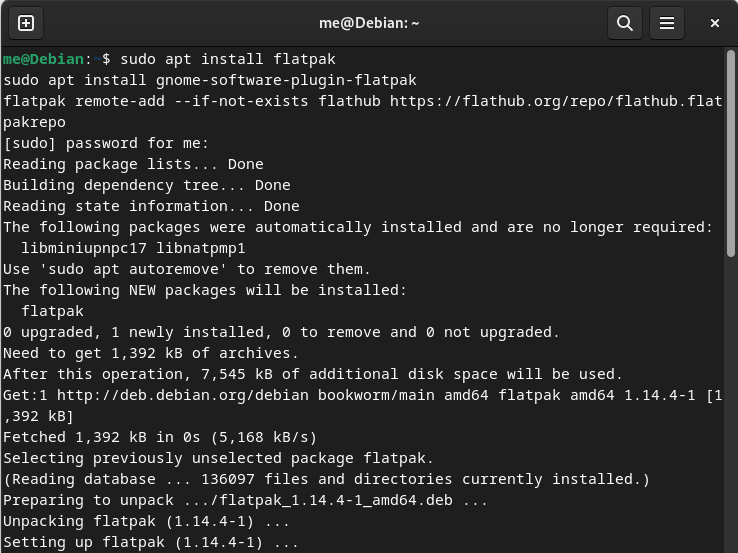
To complete setup, we may need to restart our system. After that, we can install Color Picker.
Now, Install Color Picker using flatpak:
flatpak install flathub nl.hjdskes.gcolor3

We can check all the installed flatpak application using below command:
flatpak list

The remote-add line uses dl.flathub.org, the repository host that Flathub’s own Debian setup page lists today. Flathub marks this Color Picker build as unverified and community-provided, so its developer does not support it directly.
Method 4: Installing Color Picker with Snap
Again, if you don’t have installed snap on your Linux PC, follow this guide and install using the commands according to your OS. For Debian, follow below given command:
sudo apt update
sudo apt install snapd

Ubuntu ships snapd by default, so the apt lines above only matter on derivatives that leave it out. Ubuntu already delivers some packages as snaps, and our Chromium on Ubuntu guide shows what that looks like with the Snap Store.
Now, Install Color Picker using snap:
sudo snap install gcolor3

Do not confuse gcolor3 with the colorpie snap. That one is a separate app whose store page shows a last update of 13 October 2020 and an unmaintained warning. The gcolor3 snap lists 30 November 2024 as its latest update.
Color Picker has installed using snap. We can check all the installed snap application using below command:
snap list

Now, we have successfully installed Color Picker application using all above-mentioned four methods. Now, we can just launch the application from the app grid/Menu. And use along with our productivity suite, and web development.

Usage of Color Picker
- We can select a color by changing values of RGB (Red, Green, Blue) and HSV (Hue, Saturation, Value) and save it for later use. Follow as indicated in image:
- Change RGB and HSV value as per requirement
- Set name for color
- Click on Down Arrow button to save color

Click on Saved Colors button to see saved colors.

- Eyedropper: Eyedropper feature allows selecting a color from the screen.
- Click on dropper like icon button to activate dropper
- Click on screen from where, we have to capture color
- This color will be captured
- Save it for later use

Copy Color Name value and paste it into where we can put colors by number in our desired application.
Recent gcolor3 versions store saved colors in an .ini style file, while older releases used the same file as Gcolor2. The Color Name field holds the value you copy, so you can paste it into any app that accepts a color code.
If in case, we are no longer interested in Color Picker. Then we can uninstall it.
Uninstalling Color Picker
Run the following command, depending upon the method you have chosen to install the application:
# Ubuntu / Debian / Mint
sudo apt remove gcolor3

# Fedora
sudo dnf remove gcolor3

# Arch Linux
sudo pacman -Rns gcolor3

sudo flatpak remove nl.hjdskes.gcolor3   # Removing from flatpak

sudo snap remove gcolor3         # Removing from snap
The flatpak removal accepts a –delete-data flag, which also wipes the saved data that the app keeps inside its sandbox. Without the flag the data stays on disk, so a later reinstall finds your saved colors again.
Color picker Linux support on Wayland and X11
Wayland is now the default session on major Linux distributions, and it changes how a screen color picker works. An X11 session lets any app read any pixel. A Wayland session does not, so older pickers often fail there.
Why screen pickers break on Wayland
Wayland stops apps from reading other windows, so a picker has to ask the compositor or the desktop portal for a pixel. GNOME and KDE built different interfaces for this. A KDE discussion thread describes older GUI pickers returning black or losing their pick button as a result.
Check which session you run
Run the next command in a terminal to see which session you use. It prints x11 or wayland, and the answer decides which pickers will work for you.
echo $XDG_SESSION_TYPE
If it prints wayland, choose an app that uses the portal, such as Color Picker 2.4.0 or Eyedropper. If it prints x11, xcolor and Gpick work too. The only tool here that never runs on X11 is hyprpicker.
Pickers that work on Wayland
The desktop portal exposes a PickColor method, so apps never see your whole screen. Color Picker and Eyedropper use it, while hyprpicker talks to wlroots compositors directly.
- Color Picker (gcolor3) version 2.4.0 and later
- Eyedropper, through the portal
- ColorSmith, through native portal integration
- hyprpicker, on wlroots-compatible compositors
Built-in desktop options
KDE Plasma and GNOME each have their own desktop-level options. GNOME users can try the color-picker extension, which the Eyedropper README recommends for quick one-off samples.
Other color picker Linux tools worth installing
Color Picker covers quick sampling and a small saved list. Some jobs need palette generation, more color formats or a terminal command. These six tools cover those cases. Each entry lists the install route and display server support.
Gpick
Gpick samples colors from anywhere on the screen, mixes them, generates shades and tints and exports palettes to common file formats. Ubuntu carries version 0.2.6 in universe. It targets X11, since a Fedora bug report shows it sampling black under Wayland.
sudo apt install gpick
KColorChooser
KColorChooser is a KDE palette tool that mixes colors and builds custom palettes. Its dropper reads any pixel on screen under X11. On Wayland the pick button can go missing, so treat it as a palette editor there.
sudo apt install kcolorchooser
sudo snap install kcolorchooser
Eyedropper
Eyedropper is a GNOME Circle app written in Rust that shows a picked color in a dozen formats including Hex, HSL, CMYK, CIELAB and Hunter Lab. Version 2.0 added a color editor. Its README tells GNOME users who only need a quick pick to try the color-picker extension instead.
flatpak install flathub com.github.finefindus.eyedropper
xcolor
xcolor is a lightweight picker for X11 written in Rust. Run xcolor, click a pixel and it prints the color to standard output as lowercase hex. The -f flag switches the format to HEX, rgb or plain. The -s flag stores the color in the X11 selection instead.
The rgb format helps when you colorize your Bash prompt with an exact shade.
cargo install xcolor          # builds from source and needs the xcb and Xlib libraries
sudo pacman -S xcolor         # Arch Linux
xcolor -f rgb
hyprpicker
hyprpicker is a wlroots-compatible Wayland picker that turns the cursor into a magnifying lens. It takes -f to choose the output format. The -a flag copies the result through wl-copy.
The README warns that it freezes your displays while you pick. It needs a compositor that speaks the wlroots protocols, so GNOME and KDE Wayland sessions cannot run it at all.
sudo pacman -S hyprpicker        # Arch Linux
hyprpicker -a -f hex
ColorSmith
ColorSmith replaces the ColorPicker app by the same author, whose repository was archived on 1 February 2026. It picks screen colors through native portal integration and adds a gradient maker.
Palettes can come from images through K-means clustering and move in and out as JSON. The Snap Store lists version 1.1.0 under GPL-3.0+, updated on 16 September 2026 for the stable channel.
sudo snap install colorsmith
flatpak install flathub com.ktechpit.colorsmith
Color picker Linux tools compared
This table puts the seven tools side by side. Check your session type first, since the display server decides which rows apply to you.
| Tool | Display server notes | Install route |
|---|---|---|
| Color Picker (gcolor3) | Wayland support since 2.4.0 | apt, dnf, pacman, Flatpak, Snap |
| Gpick | Black samples reported on Wayland | apt |
| KColorChooser | Pick button reported missing on Wayland | apt, Snap |
| Eyedropper | Uses the desktop portal | Flatpak |
| xcolor | X11 only | cargo, pacman |
| hyprpicker | wlroots Wayland compositors only | pacman |
| ColorSmith | Uses native portal integration | Snap, Flatpak |
- Quick sample on any desktop: Color Picker
- Palettes and shades: Gpick or ColorSmith
- Many color spaces on GNOME: Eyedropper
- Terminal workflows: xcolor on X11 or hyprpicker on Wayland
Key Takeaways
- Color Picker is the app formerly named Gcolor3, so the package is gcolor3.
- Install it with apt, dnf, pacman, Flatpak or Snap.
- Use the gcolor3 snap, not colorpie, which is a different app.
- Color Picker 2.4.0 added Wayland support.
- Wayland blocks direct screen reads, so pickers use the desktop portal.
- Black samples point to an X11-only picker on Wayland.
- Eyedropper suits advanced color formats on GNOME.
- xcolor works on X11 and hyprpicker on wlroots Wayland.
- ColorSmith adds gradients and palette tools.
Frequently asked questions
How do I install a color picker on Linux?
Run sudo apt install gcolor3 on Ubuntu or Debian, sudo dnf install gcolor3 on Fedora or sudo pacman -S gcolor3 on Arch. Flatpak and Snap builds also exist.
What is the best color picker for Linux?
It depends on your session. Color Picker and Eyedropper work on Wayland through the desktop portal. Gpick and xcolor suit X11. hyprpicker suits wlroots Wayland compositors.
Does a color picker work on Wayland?
Yes, if it uses the desktop portal. Color Picker 2.4.0 and later, Eyedropper and ColorSmith do. Older X11-only tools such as xcolor and Gpick fail or return black.
Why does my Linux color picker return black?
The picker is probably an X11 app running in a Wayland session, where apps cannot read the screen. Switch to a portal-based picker such as Eyedropper.
Which snap installs Color Picker?
Use sudo snap install gcolor3. The colorpie snap is a different app last updated in October 2020, so skip it.
How do I check if I am using Wayland or X11?
Run echo $XDG_SESSION_TYPE in a terminal. It prints wayland or x11, which tells you whether screen pickers need the desktop portal.
Conclusion
The easiest color picker Linux users can install is Color Picker, packaged as gcolor3 for apt, dnf and pacman and available through Flatpak and Snap. Check your session type first. On Wayland pick a portal-based app such as Color Picker 2.4.0 or Eyedropper. Keep xcolor and Gpick for X11 sessions.