
Blue Recorder is a free screen recording app built with Rust, GTK4 and FFmpeg. It remains one of the easiest ways to capture your desktop without installing a full-blown streaming tool. The app now runs on Windows and FreeBSD too, though this guide focuses on Linux.
It covers how to install Blue Recorder on Linux via Snap or Flatpak, launching it and using its recording, area selection and quality settings.
Some of the features of Blue Recorder are:
- Recording formats supported include mkv, avi, mp4, wmv, gif, nut and webm.
- You can choose the audio input source for the recording.
- You can set default options for recording like resolution, frames and format.
- You can select an area or a whole window for recording.
- You can disable audio or video during recording.
- You can change the directory where the recorded file is stored.
- The app was rewritten from Python to Rust with a GTK4 interface. It now also builds for Windows and FreeBSD alongside Linux.
- The recorder lets you customise recording quality with options like video format, video and audio bitrate, video codec, resolution and audio input.
Prerequisites for Installing Blue Recorder on Linux
Some of the Prerequisites you should take care of before installing Blue Recorder on Linux are:
- You should have sudo or root access to your system. Installing Blue Recorder requires administrative privileges.
- You should have a stable and fast internet connection for downloading.
- You should update your system and the package managers.
- There should be enough storage space for the application.
- Check if your Linux distro is supported by Blue Recorder. Most of the popular Linux distros are supported but you should check just to be sure.
- Snap or Flatpak (a sandboxed packaging format that bundles an app with its runtime libraries) should be installed and configured on your system. If you have not set one up yet, our guide on setting up Flatpak on Linux walks through it for every major distro.
Blue Recorder itself is not a from-scratch project. It began as a Rust rewrite of Green Recorder, an older Python screen recorder that stopped receiving updates. Every package listing for Blue Recorder still credits that lineage today. The same Rust rewrite is also why the app now builds for Windows and FreeBSD rather than staying Linux-only.
Step-by-Step Installation of Blue Recorder on Linux
Blue Recorded can be installed via snap or flatpak package manager. The steps of installation for each method are listed below.
1. Installing Blue Recorder on Linux via snap
The Blue Recorder package is available on the snap package manager’s repositories. You can install it by the following command:
sudo snap install blue-recorder
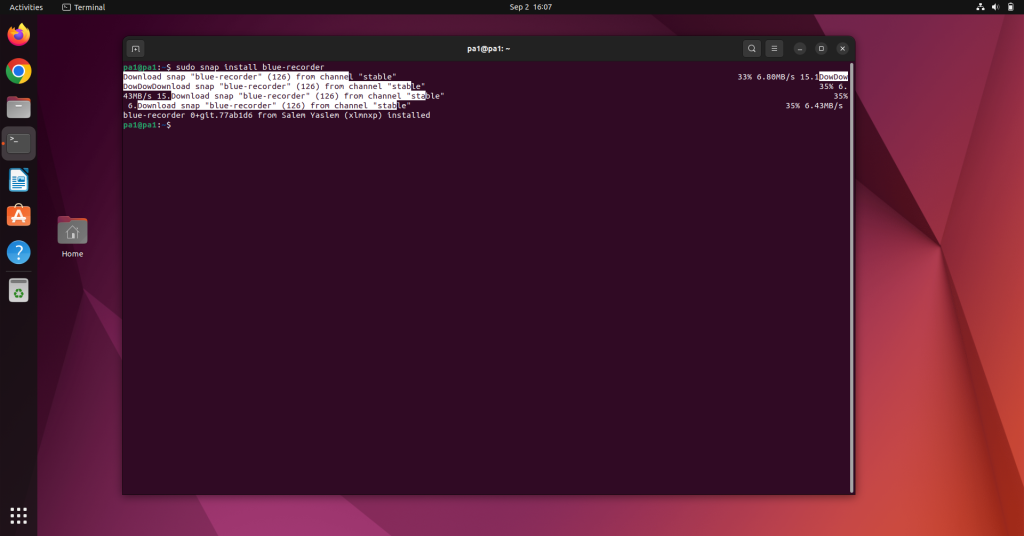
The Snap Store lists Blue Recorder’s snap under a rolling git-based version number rather than a fixed release, since the maintainer publishes straight from the latest commit. If recording or audio capture does not work right after installing, connect the interfaces the snap needs by running sudo snap connect blue-recorder:audio-record and sudo snap connect blue-recorder:screencast-legacy. Snap sandboxing blocks these by default and the app cannot see your microphone or screen until you approve them.
2. Installing Blue Recorder on Linux via flatpak
The Blue Recorder package is available on the flatpak package manager’s repositories. You can install it by the following command:
flatpak install flathub sa.sy.bluerecorder -y
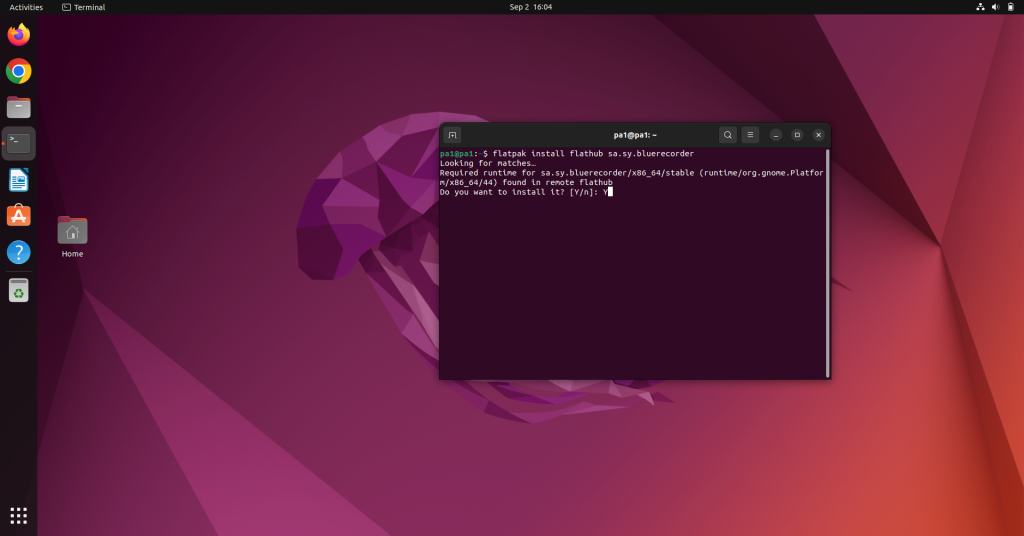
Double check the application ID above before installing, since a few older guides around the web still list com.github.maoschanz.blue-recorder. That ID belongs to a different app entirely and Flathub will fail to find it. The correct ID for Blue Recorder is sa.sy.bluerecorder.
Building Blue Recorder from source (optional)
Most readers are better off using Snap or Flatpak, but if you want the latest unreleased commit or your distro is not covered above, Blue Recorder can be built from source. You need Cargo (Rust’s package manager), FFmpeg, GStreamer, libadwaita and PipeWire installed first.
On Ubuntu or Debian-based distros, install the build dependencies with:
sudo apt install build-essential cargo clang ffmpeg gstreamer1.0-plugins-good libadwaita-1-dev libgstreamer1.0-dev libpipewire-0.3-dev pipewire-pulse pulseaudio-utils x11-utils
Then clone the repository and build it with Cargo:
git clone https://github.com/xlmnxp/blue-recorder
cd blue-recorder/
cargo build --release
cp -a data gui/interfaces locales target/release
The finished binary lands at blue-recorder/target/release/blue-recorder. This route is only worth the extra steps if you need a feature that has not reached Flathub or the Snap Store yet.
Windows and FreeBSD builds follow the same Cargo workflow but pull in their own dependency lists. FreeBSD users install ffmpeg, gstreamer1, libadwaita, pipewire and rust through pkg, while Windows needs a WinLibs toolchain, Git, FFmpeg, LLVM and GTK4 through winget, plus a switch to the GNU Rust toolchain before building.
Launching Blue Recorder on Linux
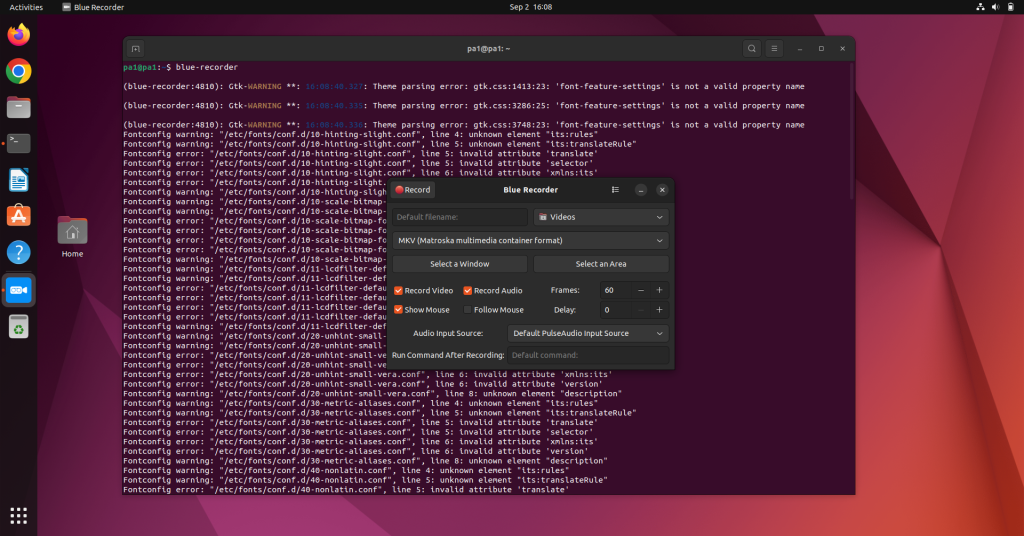
You can run Blue Recorder by finding it in the applications list and running it from there. Or if you prefer the command line then you can use the following commands:
If you’ve installed Blue Recorder via snap
blue-recorder
If you’ve installed Blue Recorder via flatpak:
flatpak run sa.sy.bluerecorder
Initiating a Screen Recording with Blue Recorder
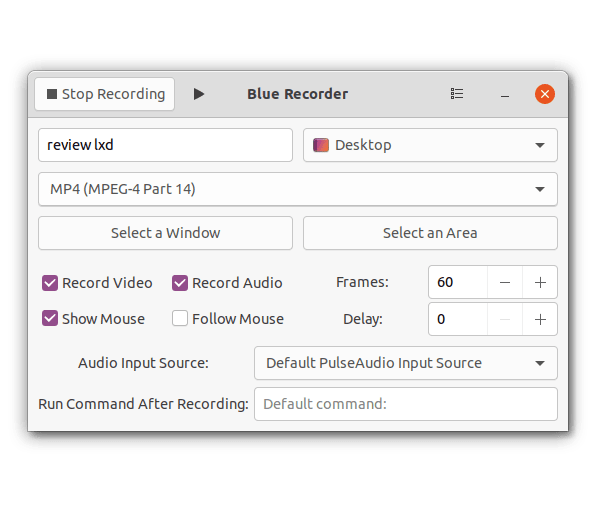
To record your screen simply open the App and click on the record button on the top left. It’ll start recording and the status will be shown just like in the following picture.
Customizing Your Screen Recording Area
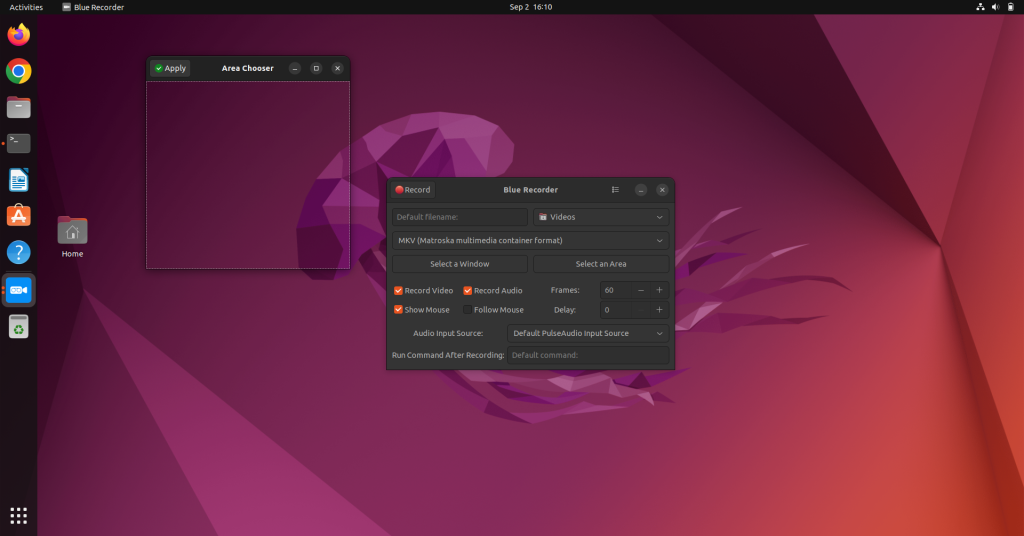
You can change the area of recording by using the “Select an Area” option. It’ll prompt you to select the area that you wish to record and then you can start recording. You can also select a particular window that you want to record.
Tweaking Video Quality Settings in Blue Recorder
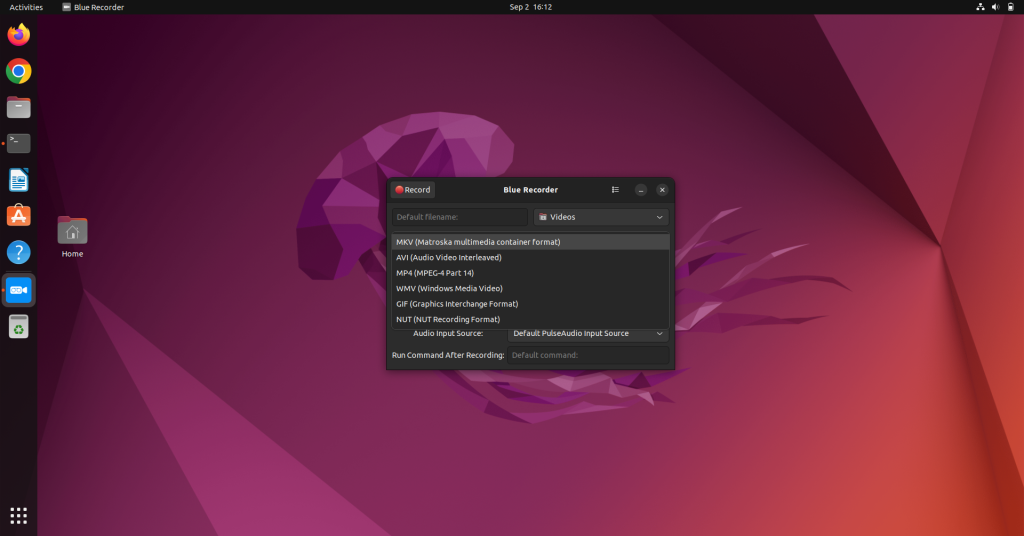
The video quality options are laid out straight away in the application. You can select the filename and beside it is the directory where the file should be stored. Then below it, you can select the format of the video. Blue Recorder supports formats like mkv, avi, mp4, wmv, gif, nut and webm, with webm reserved for GNOME’s Wayland session. If you want only the audio then uncheck the record video option. Also, If you don’t want your mouse to be shown in the recording then you can uncheck show mouse option. The Delay option sets the delay after which the recording should start. The audio input source lets you change the input sources from the available options. This is helpful in case you want to record audio via a microphone or some other audio input device.
Every format here gets encoded through FFmpeg behind the scenes, the same library that powers most Linux video tools. If you later need to convert a finished recording to a different format or codec, our guide on converting HEVC video to x264 with FFmpeg covers the command-line side of that.
Fine-tuning bitrate, codec and resolution
Blue Recorder’s advanced settings expose the same controls FFmpeg uses behind the scenes, tucked below the main format options.
- Video bitrate raises sharpness in fast-moving content at the cost of a larger file.
- Audio bitrate matters mainly for voice narration or music recorded alongside the screen.
- Video codec choice should match whatever your target platform actually supports before you switch away from the default.
- Resolution should match your display’s native resolution unless you need a smaller output file.
Stopping Your Screen Recording
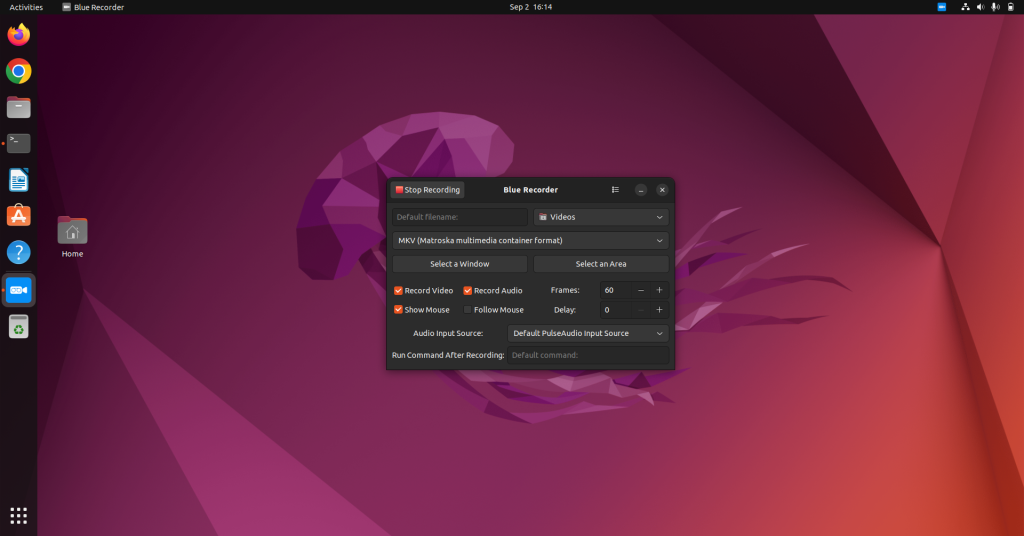
When you’ve to stop recording right-click on the icon and choose stop recording. Or use the middle click of the mouse on the recording icon in the notifications. The middle click method does not work on all Linux distros so you may check before.
Troubleshooting common Blue Recorder problems
A few issues come up often enough to cover on their own. Most trace back to sandboxing permissions or Wayland support that improved across recent releases.
- Recording finishes with no audio. This was a known bug in early versions where Blue Recorder could not find any audio source at all. It was patched in a later release, so update to the current version from Snap or Flatpak first. On the Snap build, also confirm the audio-record interface is connected as shown above.
- WebM recordings save as blank files. This was reported against the initial GTK4 preview build in late 2023, alongside missing PipeWire support in the audio selector at the time. The maintainer has since reworked WebM handling and the audio pipeline, so a current install should not hit this.
- Area selection does not appear under Wayland. Wayland handles region selection differently from Xorg. Blue Recorder’s own area capture support for Wayland arrived after the initial GTK4 rewrite. Run a current version rather than the first Rust release before assuming the feature is missing.
- Snap fails to access the microphone or screen at all. This almost always means the required Snap interfaces were never connected. Run the two
snap connectcommands from the installation section, then restart Blue Recorder.
Alternatives to Blue Recorder
Blue Recorder aims for a small no-frills feature set and it will not suit everyone, especially once your recording needs grow past a simple screen capture. A few other tools cover the gaps:
- OBS Studio handles scene composition, live streaming and webcam overlays. It stays free but asks more setup time than Blue Recorder.
- Kooha is a GTK app built only for GNOME on Wayland, trading format options for a smaller and simpler interface than Blue Recorder.
- Our roundup of the best Linux screen recorders compares seven options including SimpleScreenRecorder and VokoscreenNG.
- OnionMediaX is a Flatpak app built around FFmpeg for converting or trimming recordings after capture rather than during it.
Key Takeaways
- Blue Recorder installs via Snap (
sudo snap install blue-recorder) or Flatpak (sa.sy.bluerecorder). - Now rewritten from Python to Rust with GTK4, it also supports Windows and FreeBSD.
- Snap users may need to run
snap connectfor audio-record and screencast-legacy manually. - Supported formats are mkv, avi, mp4, wmv, gif, nut and webm.
- Record a full screen, a window or a custom area, with or without audio.
- Stop recording with a right-click or middle-click on the notification icon.
- For streaming or scene composition, OBS Studio fits better than Blue Recorder.
Frequently asked questions
Is Blue Recorder still being maintained?
Yes. It has moved from Python to a Rust and GTK4 codebase, with releases continuing to add Wayland fixes and format support through 2026.
Does Blue Recorder work on Wayland?
Yes, including area and window capture, though webm export only works inside GNOME’s Wayland session for now.
Why does Blue Recorder’s snap not detect my microphone?
The Snap sandbox blocks audio access until you run sudo snap connect blue-recorder:audio-record to approve it manually.
What is the difference between Blue Recorder and Green Recorder?
Green Recorder was the original Python tool that inspired Blue Recorder, but it stopped receiving updates and Blue Recorder replaced it as a Rust rewrite.
Can Blue Recorder record only audio?
Yes, uncheck the record video option in the settings panel before starting a recording to capture audio only.
Does Blue Recorder run on Windows?
Yes, current builds support Windows and FreeBSD in addition to Linux, though the Linux Snap and Flatpak packages remain the easiest install path.
Which video format should I pick in Blue Recorder?
MP4 works best for general compatibility. Webm suits GNOME Wayland recordings and gif fits short silent clips.
Conclusion
Blue Recorder stays a solid pick for anyone who wants a no-fuss screen recorder without wading through a full-blown streaming tool’s settings. The Rust rewrite has only made it more reliable across distros.